Video outreach is not dead. It’s just done wrong by 90% of sales teams. They blast the same generic Loom to 500 prospects. Wonder why nobody replies. Then blame the channel.
That’s not video outreach. That’s spam with a play button.
The real problem? Most teams treat video like email templates from 2019. Copy-paste. Send. Pray. But buyers in 2026 are smarter. They’ve seen every trick. They can smell a mass video blast from the thumbnail.
So how do you actually scale video outreach without becoming another ignored notification? That’s what we’re breaking down today.
Why Video Outreach Still Wins (When Done Right)
Short-form, async video is now a core sales channel. Not a nice-to-have. Buyers prefer quick, on-demand clips over scheduling calls. Especially in early and mid-funnel stages.
Think about it. Would you rather read a 500-word email? Or watch a 45-second video where someone actually shows you the thing?
Exactly.
The data backs this up. Personalized video outreach consistently delivers 3-5x higher reply rates compared to plain text, according to multiple 2026 benchmark syntheses including Vidyard’s latest report. Personalized 1:1 video via email typically achieves 12-20% reply rates, while personalized 1:1 video via LinkedIn DM hits around 15-25%. Signal-triggered personalized video (behavior-based) can reach 18-30% response rates.
But here’s the catch. It has to feel personal. It has to feel human.
Generic video that looks templated performs terribly. Platforms and audiences reward videos that feel real. Contextual. Specific to the viewer.
That’s the gap most teams miss.
The Old Way vs. The Smarter Way
Here’s what most sales teams do:
- Record one generic demo video
- Paste it into every email
- Add the prospect’s first name in the subject line
- Call it “personalized”
That’s not personalization. That’s lazy automation.
The smarter way? Context-first targeting. You use intent data. Trigger events. Behavioral signals. You determine who gets video and when.
Someone just visited your pricing page? Send them a video addressing their specific use case. A target account just raised funding? Record a 30-second clip congratulating them and tying it to your value prop.
Benchmark reports show signal-triggered personalized video delivers significantly higher reply rates than pure cold outreach. Some analyses quantify this as roughly 5x improvement (18% vs 3-4%) when outreach is structured around real buying signals.
This is how you scale without spamming.
How AI Changes Video Outreach in 2026
AI-driven hyper-personalization at scale is now standard. Not optional. Not experimental. Standard.
Modern stacks use AI to auto-generate video scripts. Talking points. Thumbnails. Personalized intros based on CRM and intent data. This replaces manual 1:1 recording for every single prospect.
You’re not recording 500 videos anymore. You’re creating smart templates. Then letting AI personalize the opening lines. The problem framing. The value proposition.
Tools like HeyGen and Synthesia generate avatar videos from text scripts in 100+ languages. Tavus offers real-time face and voice swap for true personalization at scale. These aren’t gimmicks anymore. They’re production-ready.
The typical Tavus workflow works like this: Script your core message (problem framing, value, CTA). Record a template video or choose an AI replica. Mark dynamic fields for personalization like firstName, companyName, or fundingEvent. Feed structured data from your CRM or CSV into the system. Generate thousands of personalized videos with synchronized lip movements and personalized backgrounds. Distribute via email, CRM, or outbound tools, then monitor engagement.
Some tools allow dynamic overlays. The prospect’s logo. Their name. Company data. All rendered automatically into the first seconds or thumbnail.
It looks 1:1. But you’ve scaled it to thousands.
AI-personalized video sequences are typically reporting reply rate lifts from 1-3% text baseline to 6-15% or more, representing 200-300% relative uplift. Teams adopting AI-driven video can expect 2-3x reply rate increases, 40-60% more meetings booked, and 20-30% shorter sales cycles, provided personalization and targeting are strong.
Rich Media: The Advantage Nobody Talks About
Video outreach isn’t just about recording your face. It’s about the entire experience.
What if you could send PDFs, docs, images, and even voice messages that sound exactly like you? All inside the same conversation?
This is where platforms like Sbl.so are changing the game. With Sbl.so’s rich media AI chat feature, you can send videos and other rich attachments directly over chat on LinkedIn or WhatsApp. Email support is now live too.
But here’s the crazy part. You can clone your voice.
Upload a short 10-30 second sample. Sbl.so sends personalized voice notes to your prospects. Sounding exactly like you. Thousands of personalized audios. Without recording a single one.
The richer the conversation, the more engaging it becomes. And the more results you get. This isn’t just video outreach. It’s hyper-personalized multimedia communication.
Top Video Outreach Tools for 2026
The market has matured significantly. Here are the tools worth knowing:
Sbl.so stands out for rich media AI chat across LinkedIn, WhatsApp, and email. Voice cloning from a 10-second sample. Context-aware replies that handle objections automatically. Tell the system “Share pricing on price query” and it does it when relevant. SDR profiles are available at $59-65 per profile per month depending on volume.
Vidyard remains a leader for video platforms with personalized thumbnails, CRM integration, and AI watch analytics. Their 2026 benchmark report shows video-first sequences can increase reply rates up to 5x, with notable lifts in CTR and win rate. Deals with AI avatar video are roughly 2x more likely to close.
Loom works great for quick async messaging with AI summaries and transcription. Best for demos, handoffs, and later-stage deal communication rather than high-volume cold outbound. Free tier limits scale though.
Hippo Video offers dynamic fields for name and logo insertion, sequence automation, A/B testing of video variants, and CRM sync with trigger-based campaigns.
Tavus provides real-time face and voice swap via API. Record one base video, then clone voice and face to generate thousands of personalized, lip-synced variants. Built for scale with an API-first design.
HeyGen creates AI avatar videos from scripts in 100+ languages. Consistently presented as the best overall AI avatar video tool for multilingual outbound, product walkthroughs, and explainer assets.
Sendspark is highlighted as best for record-once rep video with voice cloning across thousands of named variants, plus Gmail and Outlook integrations and personalized thumbnails.
Bonjoro integrates well with Gmail and Outlook for personalized video triggers aligned to key events like new sign-ups or trial milestones.
VideoAsk adds interactive branching logic for chat-like personalization, allowing prospects to choose paths and respond with text or video.
Outvid focuses on video outreach plus analytics with per-recipient heatmaps, completion percentages, and replay counts for outbound videos.
Each tool has trade-offs. Free tiers are limited. Enterprise plans unlock scale and spam avoidance features. Sbl.so is unique for combining voice cloning with chat continuity across channels.
Scaling Personalization: The Framework That Works
Here’s exactly how smart teams scale personalization without burning out their reps.
1. Data-Driven Audience Segmentation
You segment by industry. Role. Company size. Tech stack. Lifecycle stage. Behavioral signals like page visits and intent scores.
These segments receive tailored video storylines. Examples. CTAs. Not everyone gets the same video. They get the video that matters to them.
2. Reusable Video Templates
Create 5-10 templates for common scenarios. Problem-aware outreach. Demo follow-up. Renewal check-in. Only a few elements get personalized. Name. Company. Specific problem statement.
This is how you scale without sacrificing relevance.
3. AI-Assisted Script Generation
AI generates personalized opening lines per contact. Using CRM and firmographic data. Your reps record guided by that script. Or use teleprompter overlays inside outreach tools.
No more staring at a blank screen wondering what to say.
4. Real-Time Personalization Triggers
Connect your website, product, and email analytics via webhooks. Trigger contextual video outreach when something happens. Target account visits pricing? Send a video. Prospect re-opens a proposal? Send a follow-up clip.
Timing is everything.
5. Analyze and Iterate
A/B test watch time and reply rates. Throttle sequences for non-engagers. This protects your domain and improves results over time.
Spam Avoidance: The Rules Have Changed
Regulatory and platform pressure is tightening significantly in 2026.
Gmail and Yahoo bulk sender rules (effective since February 2024) classify any sender delivering 5,000+ emails per day to personal Gmail accounts as a bulk sender. You must implement SPF, DKIM, and DMARC correctly, support one-click unsubscribe, and keep spam complaint rates below roughly 0.10% (with strict thresholds around 0.3%).
WhatsApp Business requires explicit opt-in before business-initiated messaging and mandates pre-approved message templates for proactive outreach. Since March 2025, Meta has required a marketing opt-out button in all marketing templates. Users can opt out with one tap, and businesses must immediately cease marketing messages to those users.
LinkedIn limits have tightened too. Safe connection request range for most accounts is around 80-100 per week. Sales Navigator or high-SSI premium accounts may go higher (up to roughly 200). Recommended messaging limit is roughly 100 messages per week for free accounts and 150 per week for paid accounts. Free accounts can only send a small number of invites with notes monthly (often 5-15 notes per month).
Here’s what that means for video outreach:
- Quality over volume. Smaller, higher-intent lists with better research. Not mass sequences.
- Engagement-based throttling. Pause sequences for contacts who ignore multiple touches. Protect your domain and brand reputation.
- Transparent positioning. Frame video outreach as useful micro-education. Not pure pitch. Tutorials. Teardowns. Tailored suggestions that stand alone as value.
- Clear opt-outs. Clean preference centers where people choose content type and cadence.
Buyers are drowning in irrelevant posts and excessive ads. They punish content that feels promotional or engagement-bait. Don’t be that guy.
The Deliverability Playbook for Video
Applying current deliverability principles to video outreach:
- Reduce tracking on first touch. Some teams remove tracking pixels on initial contact. Rely on engagement during the video itself.
- Use trusted, branded domains. Host videos on branded domains or recognized platforms. Avoid unfamiliar links that trigger spam filters.
- Cadence control. No more than 1-2 video touches per week per contact. Mix channels. Avoid inbox fatigue.
- Consent-aligned sequencing. Cold contacts get lower-frequency, value-heavy educational videos. Opted-in contacts can receive more.
- Authentication. Maintain SPF, DKIM, DMARC for all sending domains. Ensure TLS, valid DNS, and consistent From: domains.
- Process opt-outs fast. Include one-click unsubscribe via List-Unsubscribe headers and process opt-outs within two days.
This isn’t rocket science. It’s respect for your audience.
Omnichannel: Video Across Every Surface
High-performing teams don’t just send video emails. They orchestrate video touches across multiple channels. Email. LinkedIn. SMS. WhatsApp. In-app messages. Landing pages.
With consistent personalization. Frequency caps. Unified profiles so the same prospect sees coherent messaging everywhere.
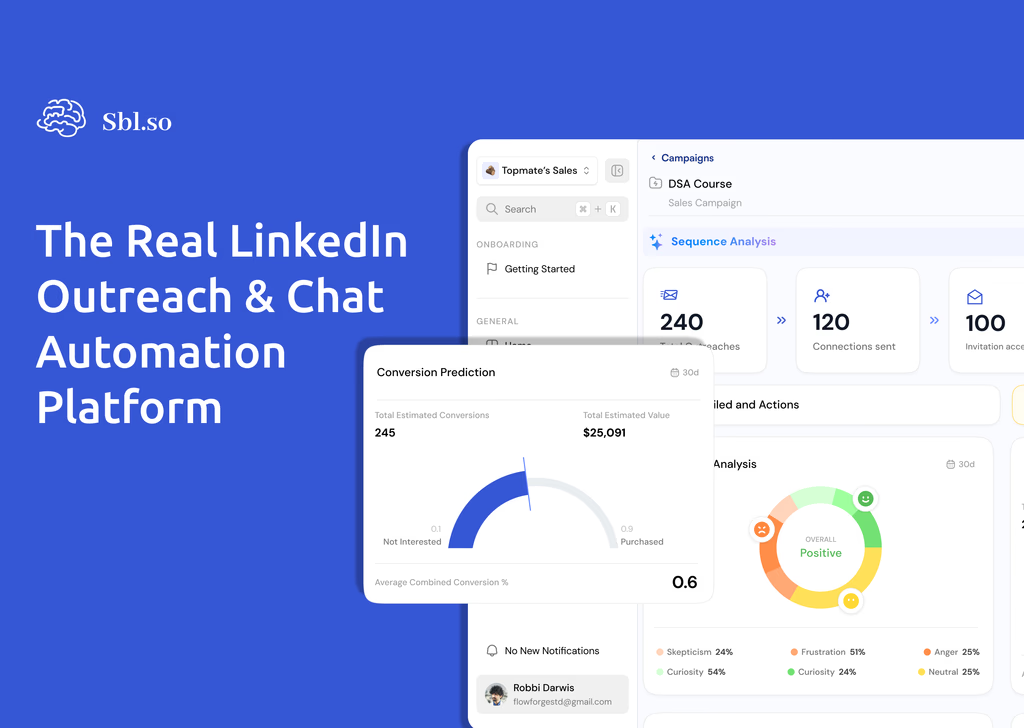
This is where LinkedIn outreach chat automation becomes critical. You’re not just sending videos into the void. You’re continuing conversations across channels.
Sbl.so supports LinkedIn, WhatsApp, and email. So you can reach leads across channels without losing context or tone.
That’s real omnichannel. Not just a buzzword on a landing page.
Self-Serve Video Experiences
Buyers want control. They don’t want to be forced onto calls.
Instead of pushing live demos, smart sellers share tailored video microsites. Hubs where buyers can watch relevant clips. Explore FAQ videos. Share internally. All without speaking to sales until they choose.
B2B teams increasingly build video microsites or hubs where prospects can consume tailored explainer clips, demos, FAQs and ROI stories without scheduling live calls. These hubs act as asynchronous demo centers, improving pre-qualification and reducing live demo load.
Self-serve video hub adoption has grown substantially according to sales benchmarks from early 2026, with strong positive impact on mid-funnel progression and opportunity creation. This respects the buyer’s time. And it pre-qualifies them before the call happens.
Win-win.
Discovery Has Shifted: AI Search and Social
How buyers find your videos has fundamentally changed.
AI-powered search and assistants are becoming the first touchpoint in the buyer journey. Not Google. AI answers from tools like Perplexity and ChatGPT. Social feeds.
For public videos on YouTube, LinkedIn, TikTok, you need structured data. Clear titles. Chapters. Descriptive captions. So AI can confidently surface your content.
Buyers also search directly on social platforms. TikTok. Instagram. YouTube. LinkedIn. For how-to content and product comparisons.
Smart teams create semi-personalized public videos. “For RevOps leaders at mid-market SaaS…” These work as outbound assets and organic discovery hooks. Interactive videos with clickable chapters are seeing higher engagement rates.
Measurement: What Actually Matters
You can’t improve what you don’t measure. Here’s the framework:
Top-funnel:
- Video play rate (aim for 50-60%+)
- Average watch time and percentage watched (above 60% is considered strong)
- CTA click-through to next step
Mid-funnel:
- Reply rates per video type (15-25% is a reasonable benchmark for strong personalized outreach)
- Meeting-booked rates
- Influence on opportunity creation
Bottom-funnel:
- Impact on win rate (contextual videos show roughly 2x higher close likelihood)
- Sales cycle length (AI-enabled video cited as cutting cycles by 20-30%)
- Deal size when video is used vs. not
Quality signals:
- Qualitative replies referencing the video
- Internal sharing (prospect forwarding to colleagues)
A/B test everything. Length. Hook. Thumbnail. CTA. Placement. This is how you find your perfect message-market fit.
Speaking of testing, AI sales funnel automation is crucial for understanding what’s working and what isn’t.
What Smarter Video Outreach Actually Looks Like
Here’s the picture:
- Context-first targeting. Intent data. Trigger events. Behavioral signals. Not spray-and-pray.
- Relevance over production. Authentic, quick-recorded videos beat over-produced generic clips.
- Role-specific narratives. Separate tracks for C-level. Economic buyers. Technical evaluators. End users.
- Threaded video sequences. Each video builds on the last. Intro. Proof. Demo. Objection handling. Recap.
- Interactive elements. Clickable overlays. Chapter markers. Links to calculators.
This is the standard now. Not some futuristic ideal.
The Sbl.so Advantage for Rich Media Outreach
Traditional outreach tools send templates. Then stop. But real conversations happen after someone replies.
That’s where most tools break.
With Sbl.so, chat automation is where the magic happens. The system doesn’t just send a message. It knows what to say. When to say it. How to handle objections. How to reply in a way that gets a response.
And with rich media support, you’re not limited to text. Send PDFs. Docs. Images. Voice messages in your cloned voice. All automatically, based on context.
Tell the system: “Share the pricing brochure when the prospect shows interest around price.” The AI does it when it’s obvious.
That’s not an if-else chatbot. That’s intelligence.
The result? Higher acceptance rates. More engagement. Better conversations.
Video Length Best Practices by Stage
Multiple 2026 benchmarks converge on clear recommendations:
Cold and early-stage outreach: 30-60 seconds is consistently recommended. Beyond roughly 90 seconds yields steep drop-offs in completion and engagement. Videos under 90 seconds show approximately 68% view-through, whereas videos beyond 2 minutes drop to around 30%.
Mid-funnel demos and explainer videos: 2-3 minutes is a practical upper bound where attention remains sustainable, especially when content is dense and tailored.
Videos that start with strong hooks referencing a specific event or problem at the prospect’s company gain 15-20 additional seconds of view time relative to generic openers.
Thumbnail Optimization
Thumbnails have become a key optimization lever. Personalized thumbnails featuring the rep’s face plus the prospect or company name deliver roughly 40% higher click-through rates than generic thumbnails.
Test different versions. Show a frame of you speaking, not a static image. Personalization in thumbnails can boost clicks by 2x.
Most Commonly Asked Questions on Video Outreach
Does video outreach still work in 2026?
Absolutely. Well-targeted, personalized video delivers 3-5x higher reply rates compared to plain text. Personalized 1:1 video via email achieves 12-20% reply rates, while LinkedIn DM hits 15-25%. The key is thoughtful execution, not mass blasts.
How personalized does a video need to be?
Contextual personalization is the sweet spot. Reference the prospect’s role, company, and a specific trigger or problem. Add light 1:1 touches like name and logo. Deep research for every individual is reserved for top-tier accounts.
What’s the ideal length for outreach videos?
30-60 seconds for cold or early-stage outreach. Under 90 seconds to keep view-through around 68%. 2-3 minutes for product walk-throughs, proposals, or complex explanations.
How do you scale without burning out reps?
AI-generated scripts. Templates. Persona libraries. Dynamic overlays. Segment-based personalization. Full custom 1:1 videos only for high-value accounts. Teams using AI-native workflows can produce hundreds of personalized videos per hour.
How do you avoid spam filters with video outreach?
Send to researched, relevant contacts. Respect consent laws. Cap frequency to 1-2 videos per week per contact. Prioritize value-driven content. Use trusted domains. Avoid deceptive subject lines. Maintain SPF, DKIM, and DMARC. Keep spam complaint rates below 0.10%.
Which channels work best for video outreach?
Email and LinkedIn remain primary for B2B. WhatsApp is growing but policy-constrained and more suitable once opt-in is obtained. Public platforms serve for discoverability and as assets you can link in direct outreach.
How does AI change video outreach?
AI assists with scriptwriting, personalization, content repurposing, and performance analysis. It powers personalization engines that decide who gets what video, when, across channels. It clones faces and voices to generate thousands of individualized outputs while preserving human-like delivery.
How do you measure video outreach ROI?
Connect video data to CRM metrics. Compare sequences with video vs. without. Look at replies, meetings, opportunities, win rates, deal sizes. Track per-prospect view and reply metrics. Run A/B tests on hooks, thumbnails, and length.
What type of video works best for outbound vs. nurture?
Outbound: quick introductions, pattern-interrupt explainers, micro-case studies. Nurture: deeper demos, tutorials, ROI breakdowns, customer stories.
Can you send video on LinkedIn and WhatsApp?
Yes. Platforms like Sbl.so support rich media messaging across LinkedIn, WhatsApp, and email. Videos, voice notes, PDFs, images. All in one conversation.
What’s the difference between video outreach and video spam?
Relevance. Timing. Value. Video outreach targets the right person with the right message at the right moment. Video spam blasts the same generic clip to everyone.
How do you make video thumbnails more clickable?
Personalize them. Show the prospect’s name or logo. Use a frame of you speaking, not a static image. Test different versions. Personalized thumbnails boost clicks by roughly 40%.
Should I use my face in outreach videos?
Usually yes. Human faces build trust. But mix it with screen shares and product demos for variety and value.
How often should you send video follow-ups?
No more than 1-2 video touches per week per contact across all channels. Mix with text. Respect inbox fatigue.
Can AI clone my voice for video outreach?
Yes. Tools like Sbl.so and Tavus let you upload a short voice sample and generate personalized voice notes at scale. Sounding exactly like you.
What’s the ROI difference between generic and AI-personalized video?
2026 commentary suggests AI-personalized behavioral video can deliver 8-10x ROI compared with generic video, largely due to higher reply rates and deeper engagement.
The Bottom Line on Video Outreach in 2026
Video outreach works. But only when you respect your audience.
That means personalization at scale. Not mass blasts. Context-first targeting. Not spray-and-pray. Rich media conversations. Not text templates from 2019.
The teams winning right now combine AI-driven personalization with human authenticity. They use tools that handle the heavy lifting. So reps can focus on high-value conversations.
They send videos that feel like they were made just for you. Even when they weren’t.
That’s the future. That’s what scales.
And if you’re still doing video outreach the old way? You’re not just losing deals. You’re training your prospects to ignore you.
Don’t be the noise. Be the signal.
For teams ready to scale AI-powered sales automation with rich media, personalized voice, and true omnichannel outreach, the tools exist today. The question is whether you’ll use them before your competitors do.