Your pipeline is leaking. And you probably don’t even know it. Sales blames marketing for sending garbage leads. Marketing blames sales for not following up. The real problem? Nobody agrees on what a qualified lead actually means.
Lead qualification is where most B2B companies silently bleed revenue. And most teams don’t notice until deals start slipping. They have MQLs. They have SQLs. But the definitions? Completely different depending on who you ask.
The MQL vs SQL Confusion That’s Killing Your Pipeline
Let me break this down simply.
MQL (Marketing Qualified Lead): Someone who showed interest and matches your ICP. Downloaded an ebook. Watched a webinar. Visited your pricing page three times. Marketing owns this stage and decides when engagement crosses the threshold.
SQL (Sales Qualified Lead): Someone sales has reviewed and accepted as a real opportunity. Has budget. Has authority. Has a real timeline. The key distinction: sales has explicitly agreed to work this lead.
Simple enough, right?
Wrong.
Here’s what actually happens. Marketing says: “They downloaded our case study. That’s an MQL. Send to sales.”
Sales says: “This person has no budget and no decision-making power. Why am I wasting my time?”
That’s not a lead problem. That’s an alignment problem.
The impact isn’t theoretical. With 84% of sales reps missing quotas last year and 67% of teams facing pipeline inefficiencies, you can’t afford to ignore this anymore. Companies that nail alignment are seeing 25%+ pipeline health improvements.
Why Sales-Marketing Alignment Actually Matters
Let me tell you what misalignment really costs you. 40% of your pipeline. Gone. Wasted on leads that never should have been passed to sales in the first place. Your SDRs and BDRs spend hours chasing people who will never buy. Your marketing team gets demoralized because “sales never closes anything.” And leadership? They’re staring at a CRM full of stale opportunities wondering what went wrong.
The fix isn’t complicated. But it requires both teams to sit down and agree on one thing:
What makes someone qualified?
Not “interested.” Qualified.
How to Define MQLs and SQLs That Actually Work
Here’s the framework I’ve seen work best.
Step 1: Start with your closed-won deals.
Look at the last 50 customers who actually bought. What did they have in common before sales ever talked to them?
- What content did they consume?
- How many touchpoints before they converted?
- What job titles? Company sizes? Industries?
That’s your MQL blueprint. This removes opinion from the equation.
Step 2: Define the sales-ready signals.
An MQL becomes an SQL when specific intent signals appear. Not just engagement. Intent.
- Requested a demo or pricing
- Asked about implementation timelines
- Mentioned budget in a conversation
- Engaged with bottom-funnel content
These signals separate tire-kickers from buyers.
Step 3: Add a Sales Accepted Lead (SAL) stage.
More teams in 2026 are adding an explicit SAL stage between MQL and SQL. Here’s how it works: Marketing qualifies and routes the MQL. Sales reviews it. If sales accepts it for active work, it becomes an SAL. Only after a meaningful conversation that confirms BANT or MEDDIC criteria does it become a true SQL.
This extra step creates accountability. Marketing can’t just toss leads over the wall. Sales has to explicitly accept or reject.
Step 4: Document and share.
Write it down. Put it in a shared dashboard. If it’s not documented, it doesn’t exist. Make sure every single person on both teams knows exactly what qualifies as an MQL, SAL, and SQL.
Quarterly reviews. Adjust based on what’s actually closing. Repeat.
Lead Scoring: The Engine Behind Qualification
Here’s where most companies mess up. They build a lead scoring model once. Maybe three years ago. And never touch it again. That’s a death sentence for your pipeline.
Lead scoring needs to be dynamic. Real-time. Predictive.
The best SaaS companies use AI-driven scoring that combines:
- Fit data (30%): Company size, industry, job title, technographics
- Intent data (35%): Pricing page visits, demo requests, competitor research, third-party intent signals
- Engagement data (35%): Page views, content downloads, video engagement, email responses, chat interactions
A lead hits 60+? That’s your MQL threshold.
80+? Sales-ready. SQL.
The magic happens when you let AI retrain every 24-48 hours based on actual wins and losses. That’s how you get 15-20% accuracy improvements every quarter. Static scoring decays fast because buyer behavior changes.
Compound scoring frameworks are gaining traction too. Instead of adding fit + intent + engagement, multiply them: Fit × Intent × Engagement. This surfaces leads that are right-fit AND actively in-market, not just high-fit but cold prospects.
If you’re still using static lead scoring from 2022, you’re leaving money on the table.
Pipeline Health: The Metrics That Actually Matter
Most teams track the wrong things. They obsess over lead volume. “We generated 500 MQLs this month!” Great. How many turned into revenue?
Here are the metrics you should actually care about:
1. Velocity
How fast do leads move through each stage? Healthy benchmark: less than 20 days per stage. If leads are sitting in “Proposal Sent” for 45 days, something’s broken.
2. Conversion Rates
MQL to SQL: 20-30% is solid for well-targeted B2B SaaS. SQL to Opportunity: 50%+. Opportunity to Closed-Won: 20%+.
If you’re below these, your qualification is off. But segment by channel and ICP before drawing conclusions. Generic benchmarks can mislead.
3. Decay Rate
How many leads are dying in your pipeline? Anything above 20% drop-off between stages means you’re either qualifying wrong or nurturing wrong.
4. Forecast Accuracy
When sales says “we’ll close $500K this quarter,” how close are they? AI-powered forecasting should get you to 80%+ accuracy by using activity and engagement data instead of just rep judgment.
5. Lead Response Time
How fast does sales contact an SQL after handoff? The benchmark is under 4 hours. Anything longer and you’re watching warm leads go cold.
Track these weekly. Not monthly. Weekly.
How AI Changed Lead Qualification in 2026
Lead qualification used to be manual. A human reviewed the lead. Made a gut call. Passed it along. That doesn’t scale. And it’s wildly inconsistent. 94% of sales teams now use AI integration as a top growth tactic. Not because it’s trendy. Because it works.
AI can:
- Score leads in real-time based on hundreds of signals
- Predict which leads are likely to close before sales ever touches them
- Auto-qualify leads through conversational AI
- Adjust scoring models automatically based on outcomes
- Apply time decay so stale engagement doesn’t inflate scores
This is especially powerful when you’re running high-volume outreach. Tools like AI sales funnel automation can qualify leads at scale without human bottlenecks.
And if you’re using B2B data enrichment tools, you’re adding firmographic and technographic data that makes scoring even more accurate.
Conversationally Qualified Leads: The New Standard
There’s a shift happening. Traditional MQLs rely on clicks and form fills. But buyers in 2026 often bypass forms entirely. They engage through chat, social DMs, and AI assistants.
A Conversationally Qualified Lead (CQL) is a lead qualified through an AI-driven conversation. The conversation captures:
- Use case and specific problem
- Urgency and timeline
- Authority and decision-making role
- Budget range and constraints
- Competitive context
The output? A full transcript plus structured data for sales to review. Early data shows CQLs convert to SQL at 2-4x the rate of traditional MQLs because the intent signal is grounded in actual dialogue, not just page views.
Some teams maintain MQL/SQL for reporting but operationally route leads based on CQL flows. If you’re running LinkedIn outreach chat automation, this is where AI qualification becomes critical. The conversation itself becomes the qualification event.
The Handoff: Where Most Leads Go to Die
You can have perfect definitions. Perfect scoring. And still lose deals at the handoff. Here’s what happens. Marketing qualifies a lead as SQL. They drop it in the CRM. Tag it. Move on. Sales doesn’t see it for 48 hours. By then, the lead went cold. Talked to a competitor. Lost interest.
Speed matters more than you think.
The best teams I’ve seen do this:
- Instant notifications: The moment a lead hits SQL threshold, sales gets pinged.
- Shared context: Full conversation history, content consumed, scoring breakdown.
- SLAs: Sales has 4 hours to make first contact. Not 48. Four.
This is where automation becomes critical. If you’re running sales automation for small teams, you need systems that handle handoffs without manual intervention.
Digital Sales Rooms and Buyer Engagement Tracking
Digital sales rooms are now mainstream. These are shared spaces where buyers can access proposals, case studies, mutual action plans, and pricing in one branded link instead of scattered emails and static PDFs.
The real value? You can track exactly what they’re looking at.
When a buyer spends 10 minutes on your implementation timeline and 2 seconds on your company history, that’s a signal. It tells you they’re past the awareness stage. They’re evaluating.
Digital sales rooms capture:
- Which stakeholders joined the room
- What documents and videos they viewed
- Time spent on specific sections
- Activity over time (re-visits, new stakeholders joining)
This kind of engagement data feeds directly into your scoring. It helps surface SQLs faster because you’re seeing intent signals you’d miss in email-only communication. It also identifies hidden stakeholders and buying committees you didn’t know existed.
For forecast calls, DSR data gives you evidence of buyer behavior instead of relying on rep intuition alone.
What About Conversational Search and Zero-Click Discovery?
Here’s a reality check. 67% of leads now discover SaaS brands through AI and social search. Not Google. Not direct traffic. They ask ChatGPT. They scroll LinkedIn. By the time they reach you, intent is already formed. They find you through a conversation, not a search result.
What does this mean for lead qualification?
Your content needs to qualify leads before they ever hit your site. The blog posts, the social content, the videos. They need to do the heavy lifting.
Think about it. Someone asks an AI assistant: “What’s the best tool for LinkedIn automation?”
If your content shows up in that answer, you’ve already qualified intent. They’re not just browsing. They’re actively looking for a solution.
That’s why optimizing for AI overviews and conversational search matters. Your MQLs are being qualified by AI before your marketing team ever touches them.
Trust as a Pipeline Health Metric
Something that’s shifting in 2026: trust is becoming measurable. Sales teams are tracking metrics like time to second meeting and content engagement depth as indicators of buyer trust.
Why does this matter for MQL/SQL alignment? Because trust signals often reveal intent earlier than traditional scoring. A lead who books a second meeting within 3 days isn’t just engaged. They trust you enough to keep the conversation going. That’s SQL behavior, even if they haven’t explicitly asked for pricing yet.
Consider adding trust-based signals to your qualification framework. They can shorten your sales cycle by surfacing ready buyers sooner.
Most Commonly Asked Questions on Lead Qualification
How do you define MQL vs SQL in 2026?
An MQL is a lead that fits your ideal customer profile and has shown engagement sufficient to merit sales outreach. Downloaded content. Attended a webinar. Visited key pages multiple times. Marketing owns this decision.
An SQL is a lead that sales has explicitly reviewed and accepted for active work. They’ve confirmed buying intent through a conversation. Requested pricing or a demo. Asked about implementation. Mentioned budget or timeline.
The key difference? MQL is marketing’s probability judgment. SQL is sales’ commitment to work the lead.
Align both teams on these definitions. Put them in writing. Review quarterly using closed-won patterns to refine your criteria.
What AI tools score leads best for SaaS pipeline health?
Predictive platforms like 6sense, Apollo.io, and Clearbit integrate with your CRM for real-time scoring. GenAI tools can qualify 40% faster than manual processes.
For teams running heavy outreach, Sbl.so includes built-in ICP filtering that scores leads automatically. You set your ideal customer profile, and the system filters out leads that don’t match before you ever reach out. SDR profiles start at $59-65 per month depending on volume.
This is especially useful if you’re doing high ticket sales automation where lead quality matters more than volume.
Why is sales-marketing alignment failing at most companies?
Three reasons.
First, different definitions. Marketing thinks MQL means “showed interest.” Sales thinks it means “ready to buy.” Neither is wrong. They’re just not aligned.
Second, no shared metrics. Marketing gets measured on lead volume. Sales gets measured on revenue. Incentives don’t match.
Third, bad handoff processes. Leads fall through cracks. Context gets lost. Nobody owns the transition.
Fix these three things and alignment follows.
How does conversational search impact lead generation?
Massively.
When people ask AI assistants for recommendations, they’re already qualified. They have intent. They’re looking for solutions.
If your content appears in those AI-generated answers, you’re capturing leads at the moment of highest intent.
This shifts qualification upstream. You’re not just scoring leads who find you. You’re attracting pre-qualified leads who were looking for exactly what you offer.
What are the latest pipeline health metrics for 2026?
Here’s what healthy performance looks like:
- Stage velocity: Under 20 days per stage
- MQL to SQL conversion: 20-30% (segment by channel)
- SQL to Opportunity: 50%+
- Opportunity to Close: 20%+
- Decay rate: Under 20% drop-off between stages
- Forecast accuracy: 80%+ with AI-adjusted predictions
- Lead response time: Under 4 hours for SQL handoffs
Track weekly. Adjust monthly. Review definitions quarterly. Benchmark against your own historical data, not generic industry averages.
How often should you update lead scoring models?
At minimum, quarterly for rule-based systems.
But the best teams let AI retrain every 24-48 hours based on closed-won and closed-lost data. This creates a feedback loop that improves accuracy over time. Static scoring models decay fast. Buyer behavior changes. Market conditions shift. Your scoring needs to keep up.
You’ll need at least 500 closed-won and 500 closed-lost records plus about 90 days of engagement history before fully predictive models become reliable. Smaller orgs should stick with rule-based scoring initially.
What’s the difference between lead scoring and lead qualification?
Lead scoring is the mechanism. It’s the points system that ranks leads based on fit and behavior.
Lead qualification is the outcome. It’s the decision: Is this lead worth pursuing?
Scoring feeds qualification. But they’re not the same thing. You can have a high-scoring lead that’s still not qualified if they’re missing key intent signals. And you can have a lower-scoring lead that becomes an SQL because they explicitly asked for pricing.
Scoring is quantitative. Qualification is the judgment call.
How do you qualify leads from LinkedIn and WhatsApp outreach?
This is where most outreach tools fall short.
They send messages. Someone replies. Now what?
If you’re manually qualifying every response, you’re wasting hours. The real value is in AI-powered qualification during the conversation itself.
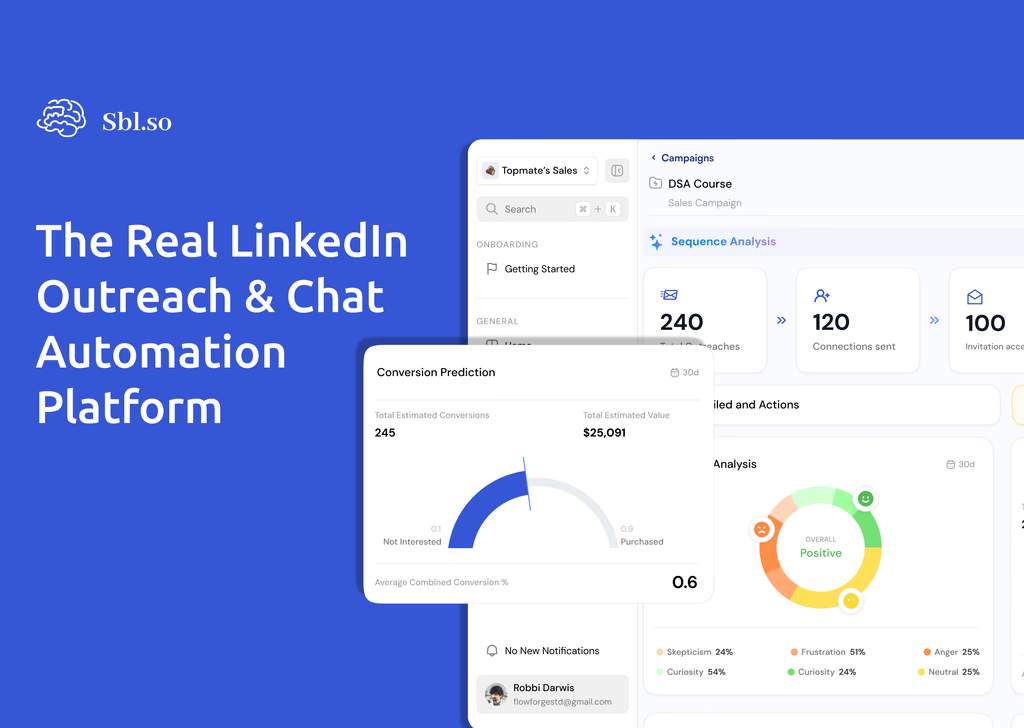
For example, Sbl.so’s AI chat automation qualifies leads in real-time during LinkedIn and WhatsApp conversations. It asks the right qualifying questions. It identifies intent signals. And it only books calls with leads that actually match your criteria.
That’s different from blasting messages and hoping. That’s AI lead qualification built into the outreach itself. You can also run LinkedIn outreach chat automation that handles responses automatically, qualifying leads without manual review.
How do team benchmarking and gamification help alignment?
Real-time leaderboards and performance tracking are becoming standard.
They create transparency across both teams. When everyone can see conversion rates by rep, you quickly spot qualification inconsistencies. Maybe one SDR is passing leads that convert at 40%, while another is at 15%. That gap tells you something.
Gamification (badges, recognition for hitting SLAs) also motivates faster handoffs and keeps both teams accountable to shared definitions.
Should we add an SAL stage between MQL and SQL?
Yes, if your MQL to SQL handoff is broken.
SAL (Sales Accepted Lead) creates explicit accountability. Marketing routes the MQL. Sales reviews and accepts or rejects. Only accepted leads become SALs. After a meaningful conversation confirming qualification criteria, the SAL becomes an SQL.
This prevents the “throw it over the wall” dynamic and gives marketing feedback on lead quality before waiting for closed-won data.
Building Your Lead Qualification Playbook
Here’s the framework. Steal it.
Week 1: Audit current definitions.
Get sales and marketing in a room. Ask: “What makes a lead qualified?” Write down every answer. I promise they won’t match.
Week 2: Analyze closed-won data.
Look at your last 50 customers. Map their journey. Find the common patterns. That’s your new MQL definition.
Week 3: Define intent signals.
What actions indicate someone is ready to buy? Demo requests? Pricing page visits? Specific questions in chat? Document these as SQL triggers.
Week 4: Implement scoring.
Build or update your lead scoring model. Weight fit, intent, and engagement data. Consider compound scoring (multiply instead of add). Set thresholds for MQL (60+) and SQL (80+).
Week 5: Create handoff SLAs.
How fast does sales need to respond? What context do they need? Build the process. Hold people accountable. Consider adding an SAL stage for explicit acceptance.
Week 6+: Measure and iterate.
Track pipeline health metrics weekly. Review definitions quarterly. Let AI retrain your scoring models continuously. Use win/loss reviews for coaching loops.
The Bottom Line on Lead Qualification
Lead qualification isn’t sexy. But it’s where revenue lives or dies.
Get MQL and SQL definitions aligned. Both teams. Same page. Written down.
Build dynamic scoring that adapts. Static models from 2022 won’t cut it anymore.
Track the right metrics. Velocity. Conversion. Decay. Forecast accuracy. Lead response time.
Automate the handoff. Speed wins.
And if you’re doing any kind of outreach at scale, make sure qualification is built into the process. Not bolted on after. Built in from the start.
That’s how you turn a leaky pipeline into a revenue machine.
Your leads deserve better. Your sales team deserves better. And your pipeline health depends on it.
For teams ready to scale qualification across LinkedIn and WhatsApp with AI, check out how Sbl.so handles real-time lead scoring and conversational qualification automatically.