Let me save you hours of confusion. SDR vs BDR isn’t just semantics. It’s the difference between a chaotic pipeline and a revenue machine. Most founders get this wrong. They hire one role expecting both outcomes.
I’ve watched countless SaaS teams burn cash on the wrong hires. They blend roles. Blur responsibilities. And end up with reps who do everything poorly instead of one thing well.
Here’s the truth. In 2026, the distinction matters more than ever. Because scale punishes ambiguity. And now, with AI agents handling the bulk of email-based outbound work, the roles themselves are evolving fast. Let me break it down.
What Is an SDR? The Inbound Qualification Engine
A Sales Development Representative handles inbound leads. Simple as that. When someone downloads your ebook, requests a demo, or signs up for a trial, the SDR jumps in.
Their job? Qualify fast. Route smart. Educate briefly.
Think of SDRs as your triage team. They’re not hunting. They’re processing demand that already exists. Marketing did the heavy lifting to get that lead. The SDR makes sure it doesn’t die in your inbox.
But here’s what’s changed in 2026: SDRs have evolved from “lead processors” to “pipeline orchestrators.” The best ones now manage 2-3 AI agents that handle initial triage while they focus on conversations that need human judgment.
Core SDR responsibilities:
- Respond to marketing-generated leads within minutes (target: under 5 minutes)
- Run discovery to determine fit and urgency
- Educate prospects on basic value proposition
- Schedule meetings with Account Executives
- Maintain clean CRM data for smooth handoffs
- Orchestrate AI agents for initial qualification and routing
- Focus on quality interactions and pipeline influence, not just meeting volume
Speed is everything for inbound SDRs. Research shows response within five minutes increases conversion by 21x compared to waiting 30 minutes. Within one hour, leads are 7x more likely to qualify than those contacted after 24 hours. Wait longer? That lead is probably talking to your competitor already.
Here’s the problem: the average response time is still 29+ hours, with 63% of companies never responding at all. This gap represents a massive competitive opportunity.
What Is a BDR? The Outbound Pipeline Creator
A Business Development Representative is different. They’re hunters. They reach out to people who’ve never heard of you. Cold. Proactive. Relentless.
BDRs build pipeline from scratch. They don’t wait for leads. They create them.
This is where most companies struggle. Small teams especially try to have one person do both. It rarely works. The mindset is completely different.
Core BDR responsibilities:
- Build targeted account lists based on ICP using intent data and signal-based triggers
- Run multi-channel prospecting campaigns across email, phone, LinkedIn, and video
- Use AI tools to handle initial outreach while jumping in for complex conversations
- Personalize at scale using trigger events (job changes, funding rounds, technology changes)
- Conduct deeper qualification than SDRs, validating fit, readiness, and decision process
- Create and qualify opportunities for AEs
BDRs need thick skin. They hear “no” constantly. But the good ones? They’re responsible for 30-50% of closed revenue in outbound-heavy organizations.
The 2026 shift: A single BDR with modern AI tools now handles the workload that previously required 2-3 reps. The best BDRs blend human relationship-building with AI-powered research and personalization.
SDR vs BDR: The Real Difference
Here’s where people get confused. Many companies use these titles interchangeably. That’s a mistake.
The difference isn’t about seniority. It’s about the source of demand. Everything else flows from that.
SDR = Reactive. Someone raised their hand. You respond.
BDR = Proactive. No one raised their hand. You create interest.
| Factor | SDR (Inbound) | BDR (Outbound) |
|---|---|---|
| Lead Source | Marketing-generated | Self-sourced |
| Primary Channel | Email, chat, phone callbacks | Cold email, cold call, LinkedIn, video |
| Key Metric | Speed-to-lead, meeting acceptance rate | Pipeline created, opportunity value |
| Mindset | Qualification and routing | Prospecting and persuasion |
| Rejection Level | Lower (warm leads) | Higher (cold outreach) |
| AI Integration | 2-3 agents for triage | 3-5 agents for outreach volume |
Neither role is “better.” They serve different purposes. The magic happens when both work together.
Contrary to expectations that AI would blur these roles, the distinction between BDRs and SDRs has become MORE critical in 2026. Organizations that tried to blend them are finding less success. The best performers maintain clear role separation even as they automate both functions with different AI approaches.
How to Structure SDR and BDR Teams for Maximum Pipeline
The old model was simple. Hire salespeople. Let them figure it out.
That doesn’t work anymore. Modern SaaS teams need structure. Here’s what high-performers are doing in 2026.
The AI-Hybrid Pod Model
Forget siloed departments. Leading companies now group SDRs, BDRs, and AEs into “pods.” Each pod owns a segment or territory. They share goals. They collaborate daily.
The 2026 pod structure has evolved:
- 1 Account Executive (focused on complex deal navigation and relationship depth)
- 1 Inbound SDR managing 2-3 AI agents for lead triage and qualification
- 1-2 Outbound BDRs managing 3-5 AI agents for prospecting and pipeline creation
- 1 Solutions Engineer (running technical deep-dives before contracts)
- Shared access to GTM Engineer who orchestrates AI agent coordination
This creates accountability while dramatically increasing capacity through AI assistance. When the BDR sources a deal and the SDR qualifies an inbound, everyone knows who contributed. The AE closes.
Channel-Specific Roles
Some teams go further. They specialize by channel.
- LinkedIn BDRs: Focus entirely on LinkedIn messaging and engagement
- Phone-first BDRs: Heavy cold calling, live conversations
- Email BDRs: Sequence-based outbound at scale
This works when you have enough volume to justify specialization. Smaller teams? Keep it simpler.
Segmentation by ICP and Complexity
Organizations are now segmenting their SDR and BDR teams not just by channel but by prospect complexity and buying group size:
- SMB segment (small buying groups): Lower-touch SDR and BDR teams, heavier AI automation
- Mid-market segment (4-6 decision-makers): Standard team structure with moderate AI support
- Enterprise segment (6-10+ decision-makers): Highly specialized teams with account-based approaches, minimal AI automation for initial meetings
Inbound vs Outbound Ratio
Here’s a rough guide based on company stage:
- Early-stage (pre-PMF): 80% outbound, 20% inbound. You don’t have brand yet. BDRs are your lifeline.
- Growth-stage: 50-50 split. Marketing is generating demand. Balance both motions.
- Mature SaaS: 30% outbound, 70% inbound. Strong brand, PLG motion, content engine. Outbound reserved for strategic accounts.
Don’t copy someone else’s ratio. Match it to your reality.
SDR/BDR to AE Ratios
Recent benchmarks show an average of about 2.6 AEs per 1 SDR across a broad sample. But this varies significantly by motion:
- High-volume inbound: 2-3 SDRs per AE
- Outbound-heavy motions: 1-2 BDRs per AE
- Enterprise: 1:1 ratio due to heavy research per account
- PLG-heavy: 1 SDR supporting 3+ AEs
AI-assisted models have shifted these ratios. One SDR/BDR managing 2-3 AI agents can now support 1-2 AEs effectively.
Hiring SDRs vs Hiring BDRs: Different Profiles Entirely
This is where most hiring managers fail. They post one generic job description. Then wonder why half their hires flame out in three months.
SDRs and BDRs require different skills. Different personalities. Different interview processes.
What to Look for in SDR Hires
The hiring profile has shifted in 2026. Focus on:
- Adaptability and learnability over tool expertise. The pace of new tools is too rapid. Someone with strong learning ability will master new platforms in weeks.
- Strong written communication. They’ll respond to leads all day.
- Active listening skills. They need to hear pain points quickly.
- Campaign analysis and optimization. SDRs now run multiple campaigns with A/B testing becoming standard.
- Comfort with AI collaboration. SDRs must work alongside AI systems, knowing when to escalate and when AI is handling appropriately.
- CRM fluency. Salesforce, HubSpot, lead routing tools.
- Time management. High volume requires prioritization.
Interview tip: Have them respond to a mock inbound inquiry. Watch how fast they qualify and how clearly they communicate.
What to Look for in BDR Hires
- High rejection tolerance with resilience. Cold outreach is brutal. Look for specific evidence of bounce-back capability in interviews.
- Comfort with cold calling. This can’t be trained easily.
- Strategic research and ICP understanding. BDRs must understand WHY certain accounts should be prioritized based on timing signals and buying behavior.
- Multi-channel proficiency. They must be comfortable across email, phone, LinkedIn, and video.
- Consultative mindset. Modern BDRs must diagnose problems, not just pitch.
- Data intelligence and signal recognition. Understanding intent data and trigger events is now essential.
- Personalization at scale. Signal-based personalization is table stakes.
Interview tip: Role-play a cold call. See how they handle objections. Look for resilience, not perfection.
Compensation Structures
Don’t pay SDRs and BDRs the same way. Their metrics are different.
SDR compensation (2026 benchmarks):
- Base salary: $50,000 to $60,000 (median around $60,000)
- On-Target Earnings (OTE): $75,000 to $95,000+
- Typically 65-70% base, 30-35% variable
- Variable tied to meetings accepted by AEs, MQL-to-SQL conversion rates, and show rates
BDR compensation (2026 benchmarks):
- Base salary: $50,000 to $60,000 (similar to SDRs)
- On-Target Earnings (OTE): $80,000 to $95,000+
- Typically 65-70% base, 30-35% variable
- Variable tied to pipeline value created, sometimes accelerators for closed revenue from sourced deals
BDRs often earn more at full quota. Makes sense. Their job is harder. Top performers in both roles can exceed $130,000 OTE.
The “Super SDR” tier: A new compensation level has emerged for SDRs who effectively manage AI agents. Base salary runs $80,000-$100,000 with total OTE of $200,000-$250,000+. These roles require the ability to manage multiple AI agents, override AI decisions when needed, and maintain pipeline quality while coordinating automation systems.
Lead Qualification: Moving Beyond BANT
Old-school sales taught BANT. Budget, Authority, Need, Timeline.
It’s outdated. Here’s why.
Modern buyers don’t have budget approval in the first conversation. They’re researching. Exploring. Your SDR demanding budget info on call one? That kills deals. Authority is often distributed across buying committees rather than centralized. The framework feels transactional.
Better Frameworks for 2026
CHAMP: Challenges, Authority, Money, Prioritization
Lead with challenges. What problem are they trying to solve? Authority and money come later. This feels less transactional and builds stronger initial rapport. CHAMP reorders BANT to start with the problem, which works better for modern discovery conversations.
MEDDIC (lite version for SDRs/BDRs):
- Metrics: What does success look like? What outcomes matter?
- Economic buyer: Who signs the check? (Understanding, not necessarily meeting)
- Decision criteria: What factors will they use to evaluate?
- Decision process: How do they typically approach buying decisions?
- Identify pain: What’s the business and personal impact?
- Champion potential: Who internally is most motivated to solve this?
SDRs should capture the basics. AEs dig deeper. The goal is spending 60% of conversation time understanding pain and 40% on framework elements.
Recommended framework stack for 2026:
- Top-of-funnel SDR calls: BANT or CHAMP for speed, plus SPIN-style questioning for pain exploration
- Mid- to late-stage AE work: MEDDIC/MEDDPICC to manage the full multi-stakeholder cycle and forecast accuracy
Signal-Based Qualification
A newer approach that’s proven highly effective uses trigger events for qualification priority:
- Job changes at target companies
- Funding rounds
- Technology stack changes
- New product announcements
- Hiring activity indicating strategic priorities
- Website behavior showing product interest
Prospects who match ICP + display multiple signals receive heavier qualification investment. Those without signals become longer-term nurture opportunities. Signal-based personalization achieves 15-25% reply rates versus generic outreach at 1-3%. Multi-signal stacking can push rates to 25-40%.
Qualification Differences by Role
Inbound SDRs: Light qualification. Focus on speed and routing. The lead raised their hand. Don’t interrogate them. Get them to the right AE fast.
Outbound BDRs: Heavier qualification. You’re interrupting someone’s day. Make sure they’re worth the AE’s time before passing them over. Validate fit, need, and urgency.
The goal isn’t to disqualify everyone. It’s to protect AE time while keeping good prospects engaged.
Outbound vs Inbound: Why You Need Both
Some founders swear by inbound. “Just create great content.” Others are outbound purists. “Cold calling is the only way.”
Both are wrong. And both are right.
When to Lean Inbound
- Strong brand recognition in your market
- Content engine producing consistent traffic
- Product-led growth motion with self-serve signups
- Lower ACV deals where high volume matters
Inbound is cheaper per lead. But it takes time to build. You can’t flip a switch and generate demand. And here’s what research now shows: the “cheap lead cost” for inbound is true in CPL but not in time-to-revenue. A hot inbound lead is worthless if your SDR team can’t respond in under 5 minutes. Most companies lose 50%+ of inbound value due to slow response times.
When to Lean Outbound
- Early stage with no brand awareness
- Enterprise or mid-market with high ACV
- Specific ICP that doesn’t find you organically
- Need for predictable, controllable pipeline
Outbound is more expensive per lead. But it’s controllable. Need more pipeline? Dial up outbound. When marketing pipeline dries up, BDR teams can increase volume within weeks. This flexibility is worth premium investment.
The Motion Mix by ACV
This breakdown holds across most B2B SaaS:
- Lower ACV (<$10K): 70% inbound, 30% outbound (relies on volume and organic search)
- Mid-market ($25K-$100K): 50-50 split (requires both strong brand and targeted outbound)
- Enterprise ($100K+): 30% inbound, 70% outbound or full ABM (requires direct targeting)
Leading companies are increasingly adopting 40-60 splits even for lower ACV because outbound for strategic accounts provides valuable pipeline diversity.
The Hybrid Model
Most successful SaaS companies run both. Here’s how they connect:
- Inbound data informs outbound targeting. What segments convert best from marketing? Target those outbound.
- Outbound warms up accounts for inbound. A BDR touches an account. Later, someone from that account downloads content. Warm inbound.
- AI sales funnel automation connects both motions seamlessly.
Don’t think of inbound and outbound as separate strategies. They’re two engines powering the same machine.
Intent Data Has Changed the Game
Intent data platforms now identify which companies are actively researching solutions. This has increased outbound effectiveness significantly because you’re reaching prospects already in-market rather than cold prospecting. Conversion rates have increased 2-3x compared to non-intent-based outbound.
Human SDR vs AI SDR: The 2026 Reality Check
Here’s where things get interesting. Everyone’s talking about AI replacing SDRs and BDRs. Let me give you the real picture.
Over 80% of sales teams are now experimenting with or using AI, with roughly 50%+ already deploying AI agents across the sales cycle. High-performing teams are 1.7x more likely to use AI prospecting/SDR agents than underperformers. This fundamentally changes how these roles operate.
What AI Can Do Today
- Research accounts and find decision-makers
- Draft personalized outreach messages using signal-based triggers
- Sequence emails across multiple channels
- Analyze intent signals and prioritize accounts
- Handle initial responses and basic qualification
- Post-call note-taking and CRM data entry
- First-pass lead scoring and routing decisions
- Meeting scheduling and calendar coordination
- Follow-up persistence without burnout
That’s significant. A lot of the grunt work that burned out SDRs? AI handles it. AI-powered tools achieve 18% reply rates versus 3-5% industry average for human-sent emails.
What AI Still Struggles With
- Complex discovery conversations with multiple stakeholder inputs
- Nuanced objection handling where emotional intelligence matters
- Multi-threading into organizations
- Building genuine relationships and trust in high-value deals
- Judgment calls on edge cases
- Strategic account planning and executive relationship building
- Deal negotiation and creative problem-solving
Here’s my take. AI won’t replace SDRs and BDRs entirely. But it will dramatically reduce how many you need.
One rep with great AI tools can do what three reps did before. That’s the shift. Real-world data shows teams going from 10+ humans in sales to 1-2 humans and 20+ AI agents while maintaining or exceeding productivity.
True AI SDR vs Automation Pretenders
The market has clarified around this distinction:
True AI SDRs (like Sbl.so): These actually conduct conversations. They handle prospects’ replies, address objections, negotiate, and book meetings autonomously. They learn from interactions and improve over time.
Automation Tools Masquerading as AI: Most tools are still just sophisticated schedulers. They send templated messages based on if-then logic. When a prospect replies, the human rep must take over.
The key differentiator: Can the tool handle a multi-message conversation, or does it stop after initial outreach?
The Hybrid Human + AI Model
Smart teams are doing this:
- AI handles research, sequencing, and initial engagement
- Humans jump in when conversations get complex
- AI learns from human interactions and improves
- Humans focus on high-ticket opportunities that need personal touch
This isn’t about AI vs humans. It’s about leveraging both for maximum output.
The Economics of AI Agents
Organizations deploying AI agents report:
- 1 human SDR/BDR with 2-3 AI agents handles workload of 2-3 traditional reps
- AI agent deployment costs: $500-$1,000 monthly per agent
- Compared to human SDR fully loaded: $100K-$130K annually
- Typical payback: 3-4 months
The math is obvious.
Most Commonly Asked Questions on SDR vs BDR
What is the main difference between an SDR and a BDR?
SDRs handle inbound leads from marketing. BDRs create outbound pipeline through cold prospecting. SDRs are reactive. BDRs are proactive. That’s the core distinction.
Which role is better for starting a sales career?
Depends on your personality. Inbound SDR is more approachable. You work with people who raised their hand. Less rejection. Outbound BDR builds prospecting resilience that’s invaluable for AE roles later. Tougher start, stronger foundation.
How should I structure SDR vs BDR teams in a SaaS company?
Separate them when volume justifies it. Have inbound SDRs process marketing leads quickly. Have outbound BDRs work named accounts or specific segments. Clear definitions of MQL, SAL, and SQO are critical. Shared playbooks help both roles align with AEs.
What’s the ideal ratio of SDRs/BDRs to AEs?
Common ratios range from 1:1 to 1:3. Recent benchmarks show about 2.6 AEs per SDR on average. Enterprise motions with heavy outbound often have 1:1 ratios. SMB with strong inbound might have 1 SDR supporting 2-3 AEs. AI-assisted models now have 1 SDR/BDR managing 2-3 AI agents supporting 1-2 AEs. Match it to your deal complexity and cycle length.
How are SDRs and BDRs compensated differently?
SDRs are usually measured on meetings accepted by AEs, MQL-to-SQL conversion, and show rates. BDRs are measured on pipeline value created and sometimes closed revenue from deals they sourced. Both typically earn $75,000-$95,000+ OTE with 65-70% base and 30-35% variable. BDRs often have slightly higher OTE potential because their role is more difficult.
What skills make a successful SDR vs BDR?
SDRs need active listening, clear communication, time management, CRM discipline, and comfort working alongside AI. BDRs need persistence, cold calling comfort, research creativity, objection handling, multi-channel proficiency, and consultative thinking. Different skill sets for different roles.
How do outbound and inbound work together?
Data flows both ways. Inbound reveals what segments convert best. Outbound targets those segments proactively. When a BDR touches an account and that account later engages inbound, context is shared. Both motions inform and accelerate each other.
Is AI replacing SDRs and BDRs?
Not entirely. AI is augmenting and partially automating their work. AI agents reliably handle research, targeting, initial outreach, and simple qualification. But humans remain essential for complex conversations, relationship building, and nuanced qualification. The trend is fewer reps doing more with AI assistance. One human with AI tools handles what 2-3 traditional reps did.
Can one person do both SDR and BDR work?
Technically yes. Some companies run “allbound” SDR roles. Practically? It’s hard. The mindsets are different. Inbound requires speed and processing. Outbound requires resilience and prospecting. Blended roles often underperform in both areas. If you must combine them, set clear KPI separation and time allocation.
How do I know if my SDR/BDR team is performing well?
SDR metrics: speed-to-lead (target under 5 minutes), MQL-to-SQL conversion (target 30-40%), show rates (target 80%+). BDR metrics: activities-to-meeting ratio, pipeline created ($250K-$500K+ monthly), opportunity value, contribution to closed revenue. Track both inputs and outputs.
What’s the typical ramp time for new SDRs vs BDRs?
Inbound SDRs: 2-4 weeks to 50% productivity, 6-8 weeks to full. Outbound BDRs: 4-6 weeks to 50% productivity, 3-6 months to full. AI-assisted roles ramp faster because AI handles research and outreach volume. Note that first-year attrition runs 30-40% in SDR/BDR orgs, making strong onboarding and coaching critical.
Why Most LinkedIn SDR Teams Are Still Doing It Wrong
LinkedIn has become the default channel for B2B prospecting. And almost everyone does it poorly.
They use “automation” tools that just send template messages. If connection accepted, send this. If no reply, send that. They call it AI. It’s just a scheduler with if-else logic.
Real LinkedIn SDR work requires:
- Personalized messages that don’t feel copy-pasted
- Engaging with content before pitching
- Handling replies intelligently
- Following up without being annoying
- Knowing when to push and when to back off
Most “automation” tools fail at everything after the connection request. They send the message. Then you’re on your own for the actual conversation.
That’s where the real work happens. And that’s what separates good BDRs from great ones.
Multi-channel coordinated outreach is landing at 4-7% conversion rates with 30%+ higher meeting conversion rates compared to single-channel approaches. Best-in-class teams use 8-12 touches across 3+ channels over 10-21 days. LinkedIn compliance and ethics matter more than ever. Aggressive sequences risk account bans and brand damage.
Sbl.so: The AI SDR That Actually Works
I’ve tested dozens of LinkedIn automation tools. Most are glorified schedulers. They don’t do the hard part.
Then I found Sbl.so. It’s different.
Here’s what makes it an actual AI SDR rather than another automation tool:
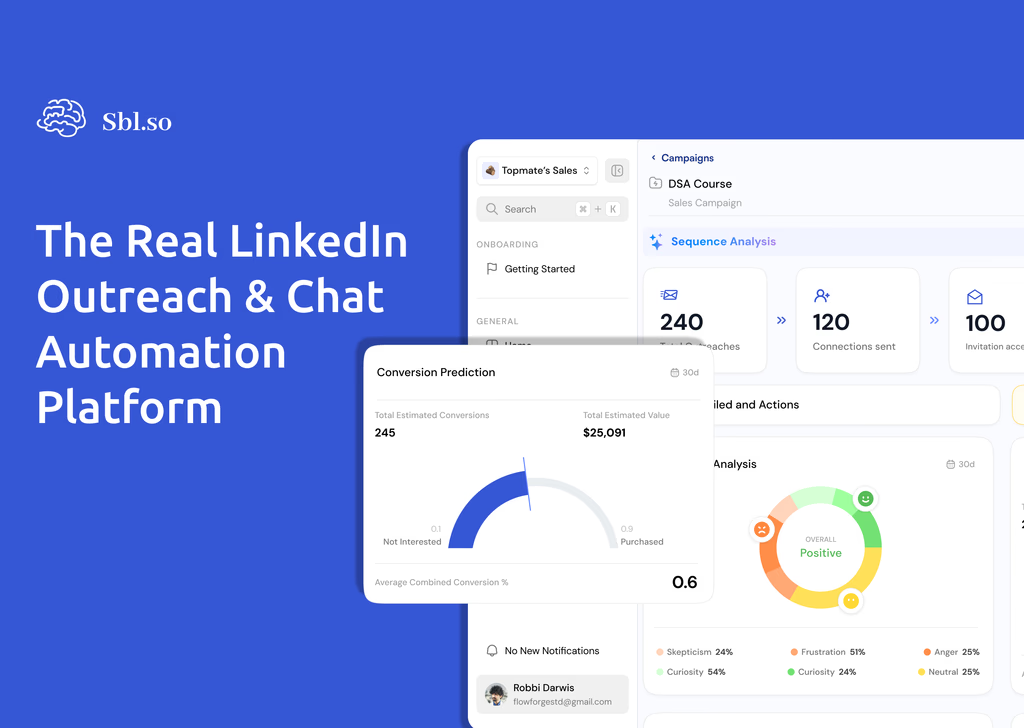
It handles the conversation. Not just the first message. When prospects reply, Sbl.so’s AI continues the chat. It handles objections. It persuades. It books calls. You don’t need humans managing every inbox.
It finds your leads. Tell it your ICP. It builds targeted lists. No more hours on Sales Navigator manually exporting.
It learns from you. When the AI doesn’t know how to handle something, it flags it. You respond. The system learns. It won’t ask about the same thing twice.
It works across channels. LinkedIn and WhatsApp today. Email coming. Omnichannel from one dashboard.
It scales without getting banned. 40,000+ reach-outs per month. Natural timing patterns. Dedicated IPs. Account rotation. Real safety, not promises.
Affordable SDR profiles. Sbl.so’s SDR profiles cost $65 per profile per month for under 10 profiles, or $59 per profile per month for 10+ profiles. Compare that to $100K+ annually for a human SDR.
This is what an AI SDR should be. Not another tool that makes you do all the work in a fancier interface.
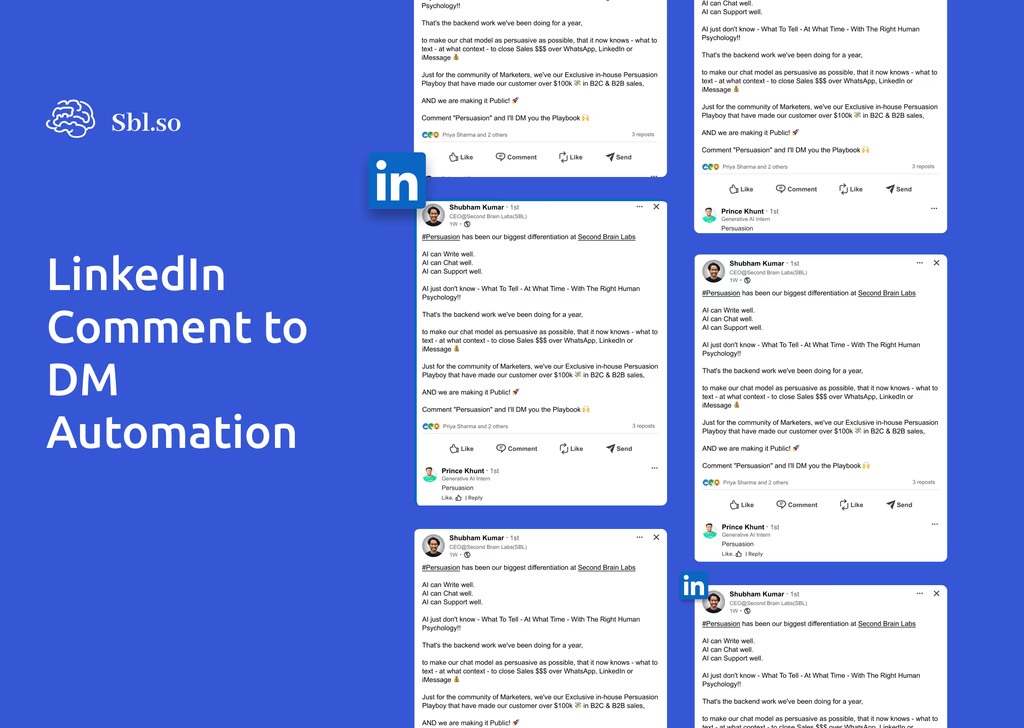
You can also use comment-to-DM automation for inbound LinkedIn leads or tap into their data enrichment to qualify leads before outreach.
Building Your Sales Development Engine: The Action Plan
Enough theory. Here’s what to do.
Step 1: Define Your Roles Clearly
Write down exactly what SDRs will do. Write down exactly what BDRs will do. No overlap. No ambiguity. Share it with the team. This is the #1 differentiator between high and low-performing teams.
Step 2: Match Hiring to Role Requirements
Stop posting generic “Sales Development” jobs. Create SDR-specific and BDR-specific job descriptions. Test for the actual skills each role needs. Hire for learnability over tool expertise.
Step 3: Set Clear Handoff Criteria
What makes a lead “Sales Qualified”? Write it down. Everyone from marketing to AEs should agree. Measure what % of SDR-qualified meetings the AE accepts. This single metric drives alignment.
Step 4: Build Qualification Playbooks
Give SDRs and BDRs specific frameworks. What questions to ask. What answers qualify. What disqualifies. Make it repeatable. Use CHAMP or MEDDIC-lite for first-touch, MEDDIC/MEDDPICC for deeper AE qualification.
Step 5: Implement the Right Tech Stack
CRM. Sales engagement platform. Intent data. And yes, AI tools that actually reduce work rather than create it. Compare options carefully. The three-tool minimum: data layer, engagement platform, CRM. Optional but increasingly critical: intent data provider, revenue intelligence, AI SDR assistant.
Step 6: Create Feedback Loops
AEs should tell SDRs/BDRs which leads close and why. Marketing should hear what messaging works. Create monthly feedback loops where AEs share wins and losses. Everyone improves together.
Step 7: Review and Iterate
Monthly pipeline reviews. What’s working? What’s not? Adjust ratios, scripts, targeting, and tools based on data.
Step 8: Build AI-Ready Infrastructure
If deploying AI, ensure you have strong CRM capabilities, verified contact data, defined personas and ICP, and clear messaging frameworks. AI amplifies good processes and bad ones. Don’t deploy AI on top of broken processes.
The Bottom Line on SDR vs BDR
SDRs and BDRs aren’t interchangeable. They’re two distinct roles serving different parts of your pipeline.
SDRs process demand. BDRs create it.
Get the structure right. Hire the right profiles. Give them clear playbooks. Arm them with tools that actually help.
And for LinkedIn outreach specifically? Consider whether you need a team of humans or an AI SDR like Sbl.so that does the heavy lifting for you.
The companies winning in 2026 aren’t just hiring more reps. They’re building smarter systems. Systems where human talent focuses on high-value conversations while AI handles the volume. One human with AI assistance now handles what three reps did before.
The future isn’t human vs. AI. It’s human + AI working as a unified system. Organizations that navigate this shift will have significant competitive advantages in pipeline generation, sales efficiency, and ultimately, revenue growth.