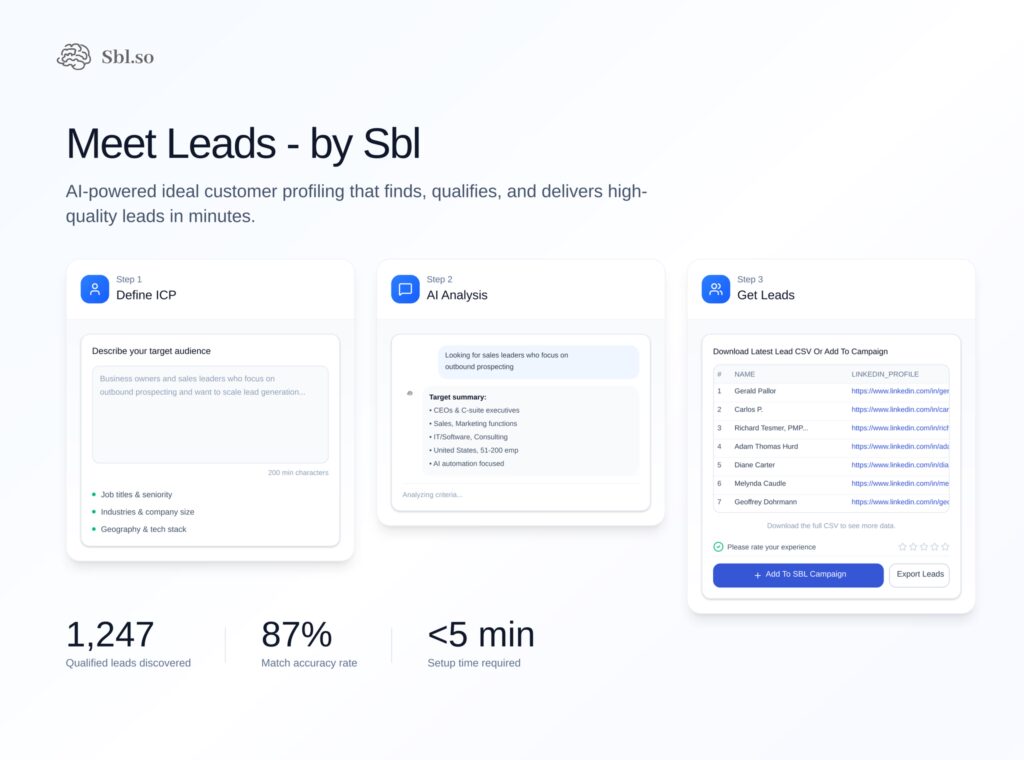
Struggling with sales outreach, lead generation, or just finding enough hours in the day? ChatGPT for sales is the solution you need.
This guide shows how top-performing sales teams are using ChatGPT sales prompts and AI sales prompts to save time, personalise at scale, and close more deals faster.
TL;DR: How to Use ChatGPT for Sales
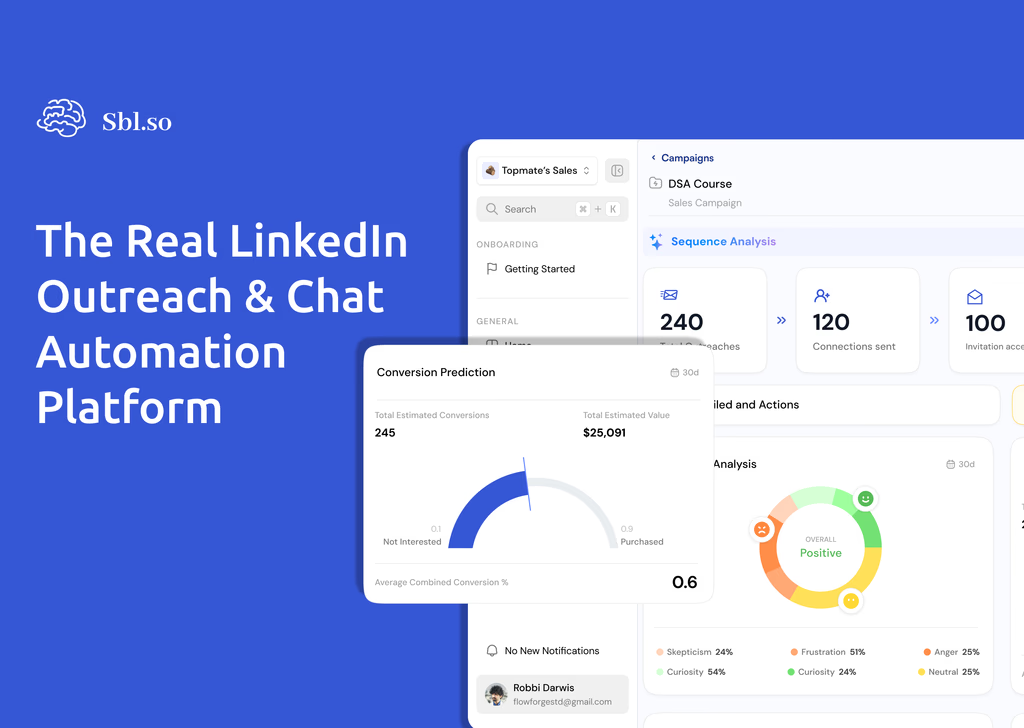
ChatGPT has evolved from a drafting tool into a connected sales workflow system. Top use cases: prospect research, personalized outreach, call summaries, pipeline analysis, objection practice, and follow-up generation. The winning pattern is verified context + structured prompts + human review + workflow integration. For AI-powered LinkedIn outreach, WhatsApp automation, and email campaigns, Sbl.so handles multi-channel sales automation at scale.
What is ChatGPT, and Why Sales Teams Love It
ChatGPT, developed by OpenAI, is an advanced artificial intelligence chatbot built upon a Large Language Model architecture called Generative Pre-trained Transformer. Trained on a massive dataset of text and code, it can understand complex queries, generate human-like text, and perform a ton of language-based tasks.
For sales pros, ChatGPT isn’t just a novelty. It’s a Sales AI assistant and, more accurately in 2027, a full sales workflow system. Think of it as a productivity engine that can draft emails, research the market, generate sales scripts, summarise meetings, analyse pipeline data, and more.
In 2027, ChatGPT has evolved from a standalone writing tool into something far more useful: a core part of the sales stack. Teams are now using it for prospect research, outreach drafting, objection handling, call prep, CRM-related analysis, and follow-up generation. The biggest shift this year is connected business applications. ChatGPT now integrates directly with CRM systems like Salesforce and HubSpot, email platforms, call systems, and data warehouses. This means sellers can work from a shared customer picture without switching between applications.
Another major development is workspace agents. These can perform repeatable tasks, use connected applications, run inside ChatGPT or Slack, and execute on a schedule. Sales teams are using agents for account monitoring, meeting preparation, follow-up generation, and CRM administration.
Custom GPTs and saved context remain valuable. Sales teams preserve ICP details, pricing, positioning, and playbooks across repeated workflows instead of starting from scratch every time. Integration with the sales stack through APIs and tools like Zapier, Make, and CRM plugins means ChatGPT now lives inside existing workflows rather than in a separate browser tab.
One rule remains constant: human review is non-negotiable. ChatGPT can still produce outdated, incomplete, or incorrect output, especially when asked to infer current market facts. Use it for drafting and analysis, not final sending or final decision-making.
How ChatGPT Works (Simplified):

How ChatGPT Helps Sales Teams
- Write personalised emails in seconds
- Research companies and find pain points
- Create sales scripts for different situations
- Summarise long meeting notes and call transcripts
- Help you practice handling objections
- Analyse CRM exports and pipeline data for patterns
- Generate sales enablement content like battle cards and pitch decks
- Identify upsell and cross-sell opportunities from account data
- Connect to business applications for real-time customer context
- Run scheduled workflows through workspace agents
ChatGPT works best when you give it detailed instructions. The more specific you are, the better the results. Learning good ChatGPT sales prompts is key to your success.
AI-powered tools for sales forecasting are helping teams reclaim up to 65% of their time, shifting the focus from spreadsheets and data crunching to engaging prospects and nurturing leads.
According to HubSpot’s State of AI in Sales Report, 43% of sales professionals say they use AI at work. Of those, 47% use generative AI tools like ChatGPT to help write sales content or outreach messages.
ChatGPT for Lead Generation and Outreach
One of the most powerful uses of ChatGPT for sales is to supercharge ChatGPT lead generation and sales outreach. Sales reps spend a lot of time researching and crafting initial messages.
Salesforce’s State of Sales Report says that sales reps spend only 28% of their time actually selling. The rest is consumed by administrative tasks, research, and internal meetings.
ChatGPT can cut research and drafting time dramatically, so you can focus on building relationships and closing deals.
1. Deep Audience Research and Industry Analysis for Targeted Prospecting
Before you reach out to anyone, you need to understand their world. ChatGPT sales prompts can help you research faster and better.
Start by asking ChatGPT to generate buyer personas for specific industries or roles.
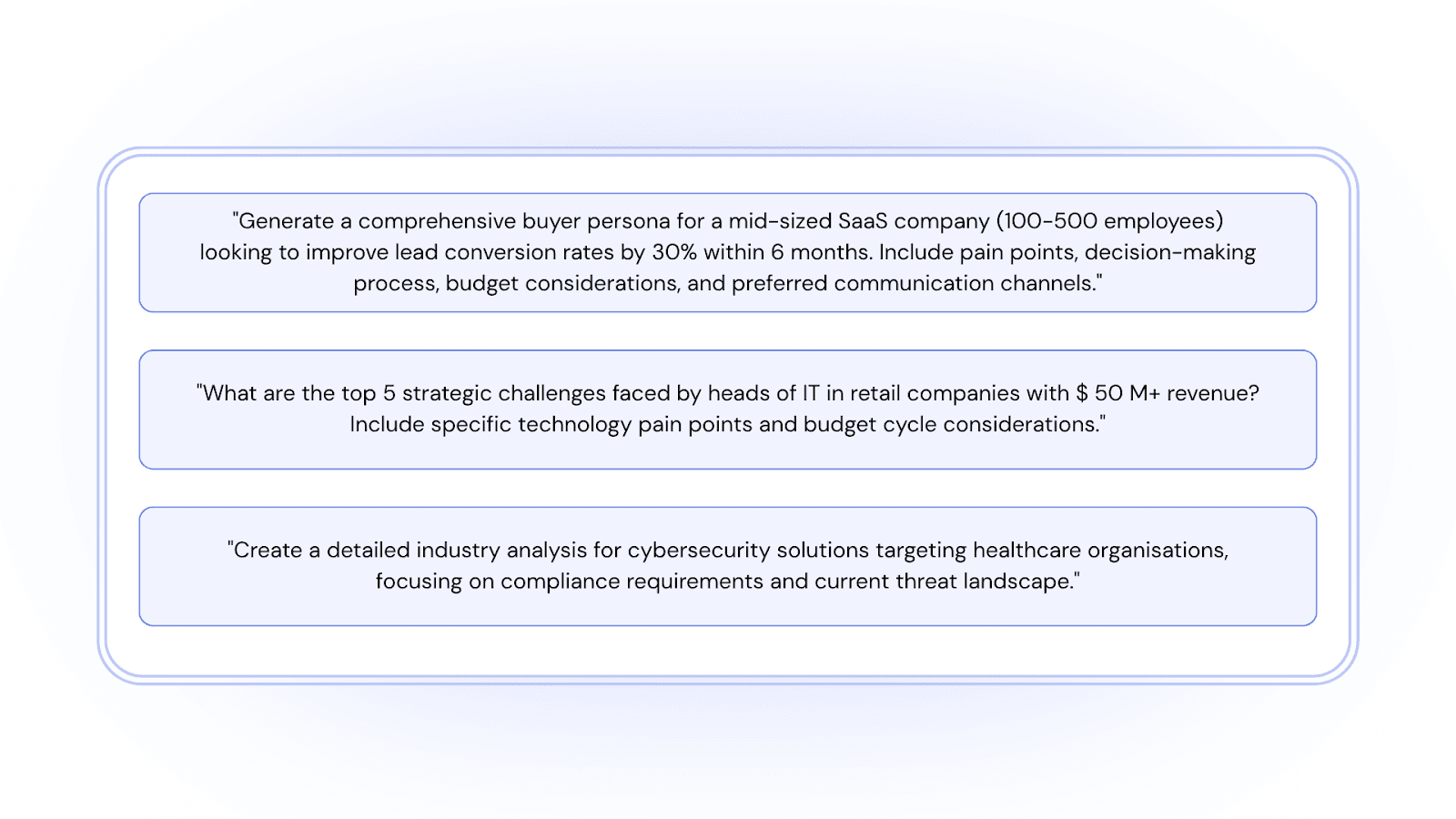
Analyse strategic challenges faced by specific roles (e.g. “heads of IT in retail companies”) or request industry analysis on compliance, threats, or market trends.
Key to success: Combine ChatGPT’s output with current news and company announcements. Use industry-specific language in your prompts for more accurate results. Build a library of research frameworks to make this process even faster.
ChatGPT is most effective when you feed it real prospect context such as recent company news, LinkedIn posts, funding stage, public pain points, and ICP-specific details. With connected CRM integrations, you can pull this context automatically rather than copying it manually.
2. Mastering Prospecting with Personalised AI Sales Prompts
Prospecting takes up to 40% of a sales rep’s time. ChatGPT lead generation prompts for B2B companies (and B2C) can help create highly personalised outreach at scale.
How can ChatGPT help your sales outreach? By enabling mass personalisation. Layer multiple data points into your prompts, such as company news, social media activity, or mutual connections, to create highly relevant messages.
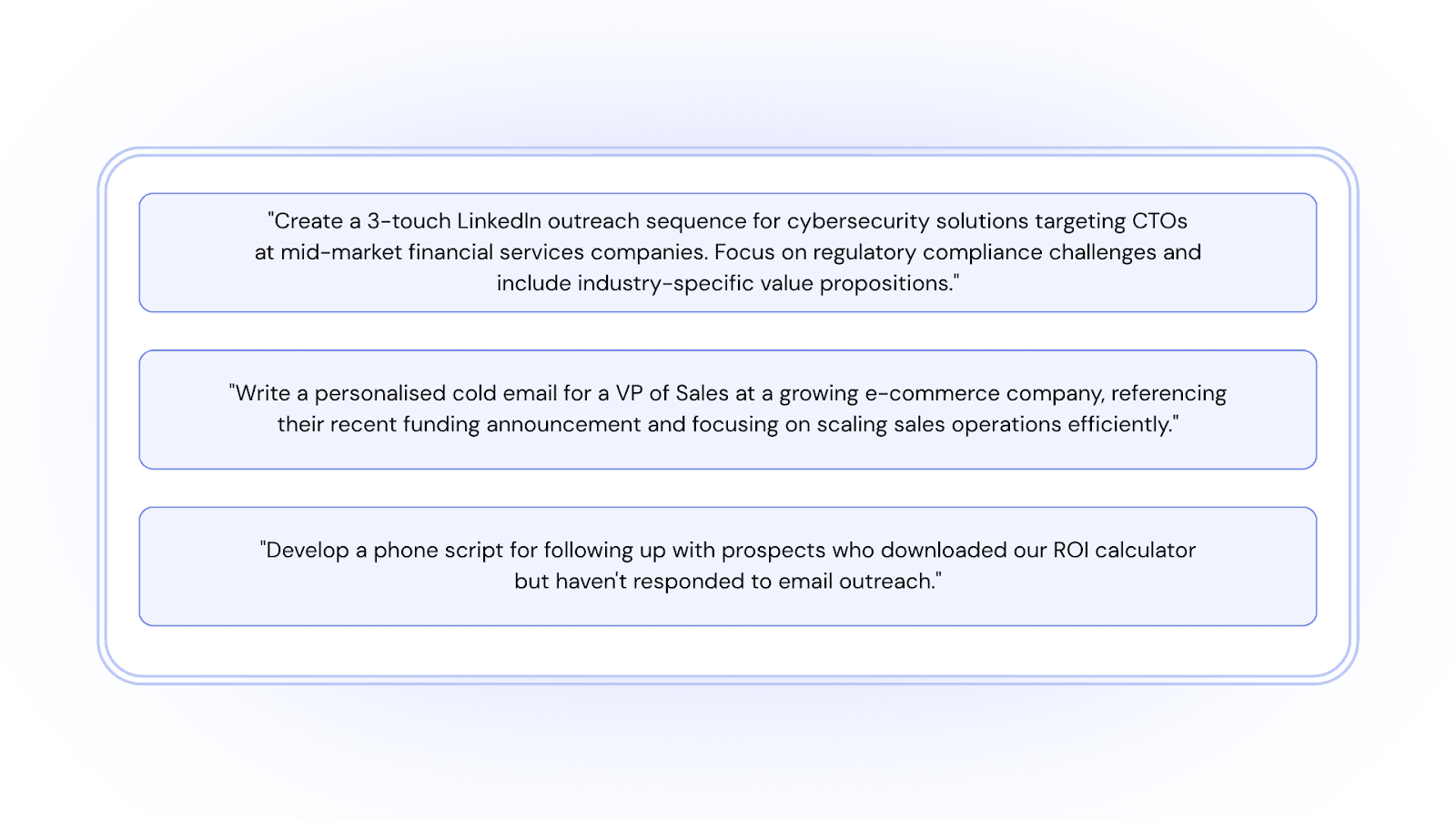
Create prospecting sequences rather than single messages. For example, ask ChatGPT to “Create a 3-touch LinkedIn outreach sequence for cybersecurity solutions targeting CTOs at mid-market financial services companies, focusing on regulatory compliance challenges.”
Test different value propositions and track response rates to optimise your lead-gen prompts. The current best practice is to generate short, specific, human-edited outreach rather than long AI-written emails, especially when the message depends on a trigger event or recent company development.
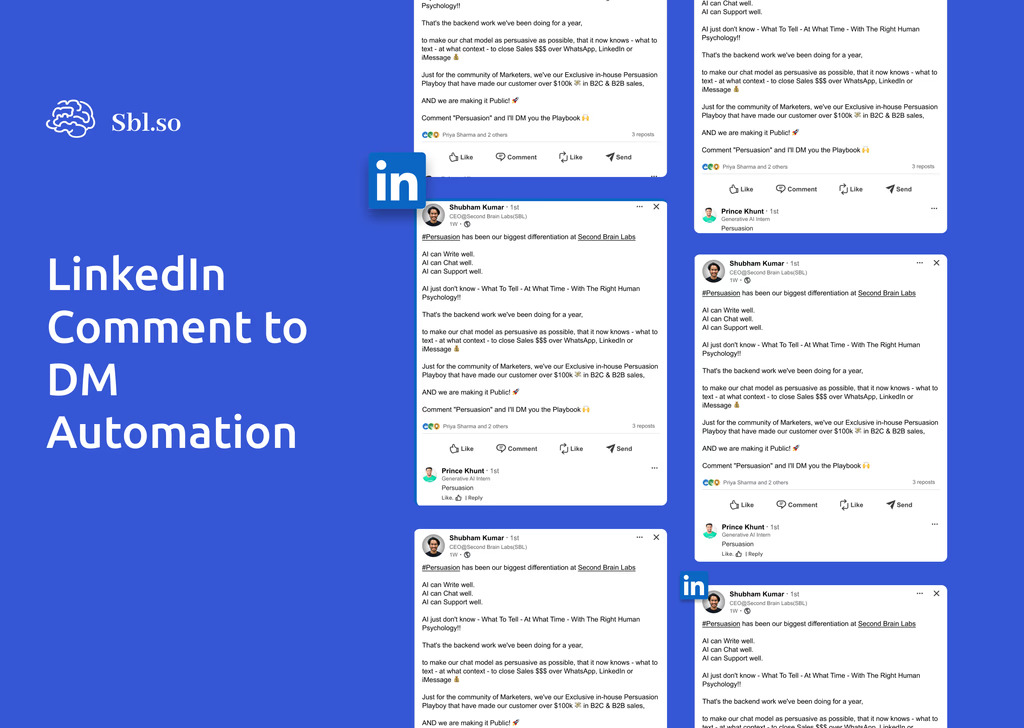
For more on LinkedIn prospecting, check out our guide on how to generate B2B leads using LinkedIn + AI in 2027.
ChatGPT Sales Prompts and Script Templates
The quality of your communication can make or break a deal. ChatGPT sales prompts and sales prompt templates are gold for creating consistent messaging across all touchpoints.
1. Dynamic Sales Script Creation for Every Scenario
Whether it’s a cold call, a product demo, or an onboarding session, clear messaging is key. ChatGPT can help you create step-by-step ChatGPT sales script templates for different audiences and scenarios.
You create them with ChatGPT. For example: “Write a 45-second cold call opener for [specific product] addressing [specific pain point] for [target role] at [company size]. Include a hook, value proposition, and clear next step.”
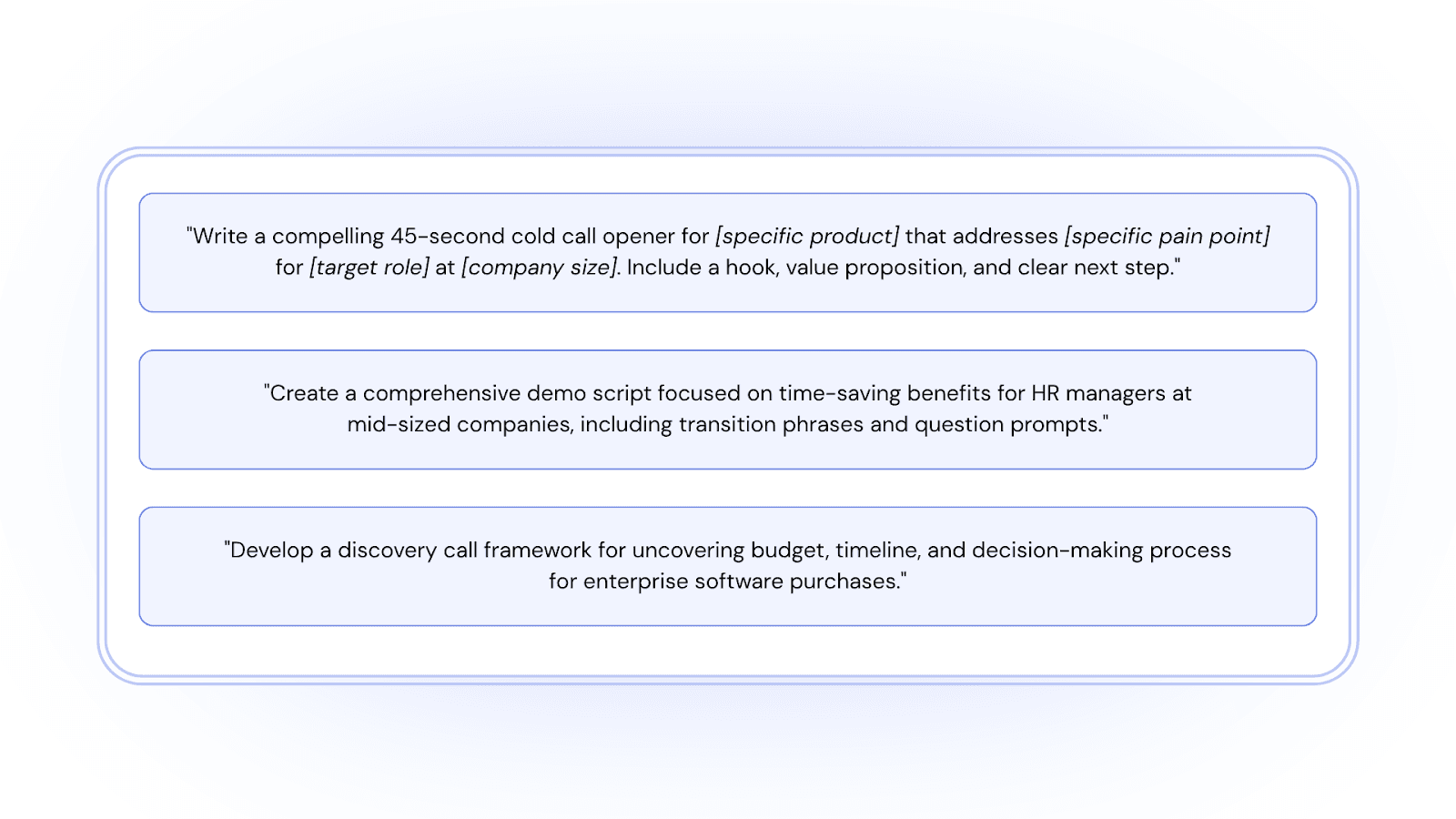
Create modular scripts that can be customised. Include transition phrases and question prompts for natural conversation flow.
Come up with scripts for different stages of the buying journey, including ChatGPT cold-call script prompts and discovery call frameworks.
2. Personalised Cold Outreach and Follow-Up Sequences
Personalised emails outperform generic ones by a long shot. ChatGPT helps you do this efficiently.
Give ChatGPT as much context as you can about the prospect. Reference their industry, recent achievements, or challenges.
For example: “Generate a personalised cold email to a CMO at a direct-to-consumer brand struggling with campaign ROI measurement. Reference recent industry trends and include a specific value proposition.”

Create ChatGPT sequences for follow-up emails. Develop trigger-based sequences for different scenarios, like post-webinar follow-ups or re-engaging cold leads.
Which ChatGPT prompts get replies? Those that are super specific, value-driven, and empathetic to the prospect’s situation. Check our ChatGPT cold email prompt examples by focusing on pain points and solutions.
For more cold outreach strategies, read our guide on how to personalize cold outreach at scale in 2027.
Using ChatGPT for Deeper Sales Insights and Efficiency
Beyond initial outreach, ChatGPT can help with other sales tasks, giving you valuable insights and saving your time.
1. Competitive Analysis
Understanding your competitors is important. ChatGPT can help you identify their strengths and weaknesses and develop counter-strategies.
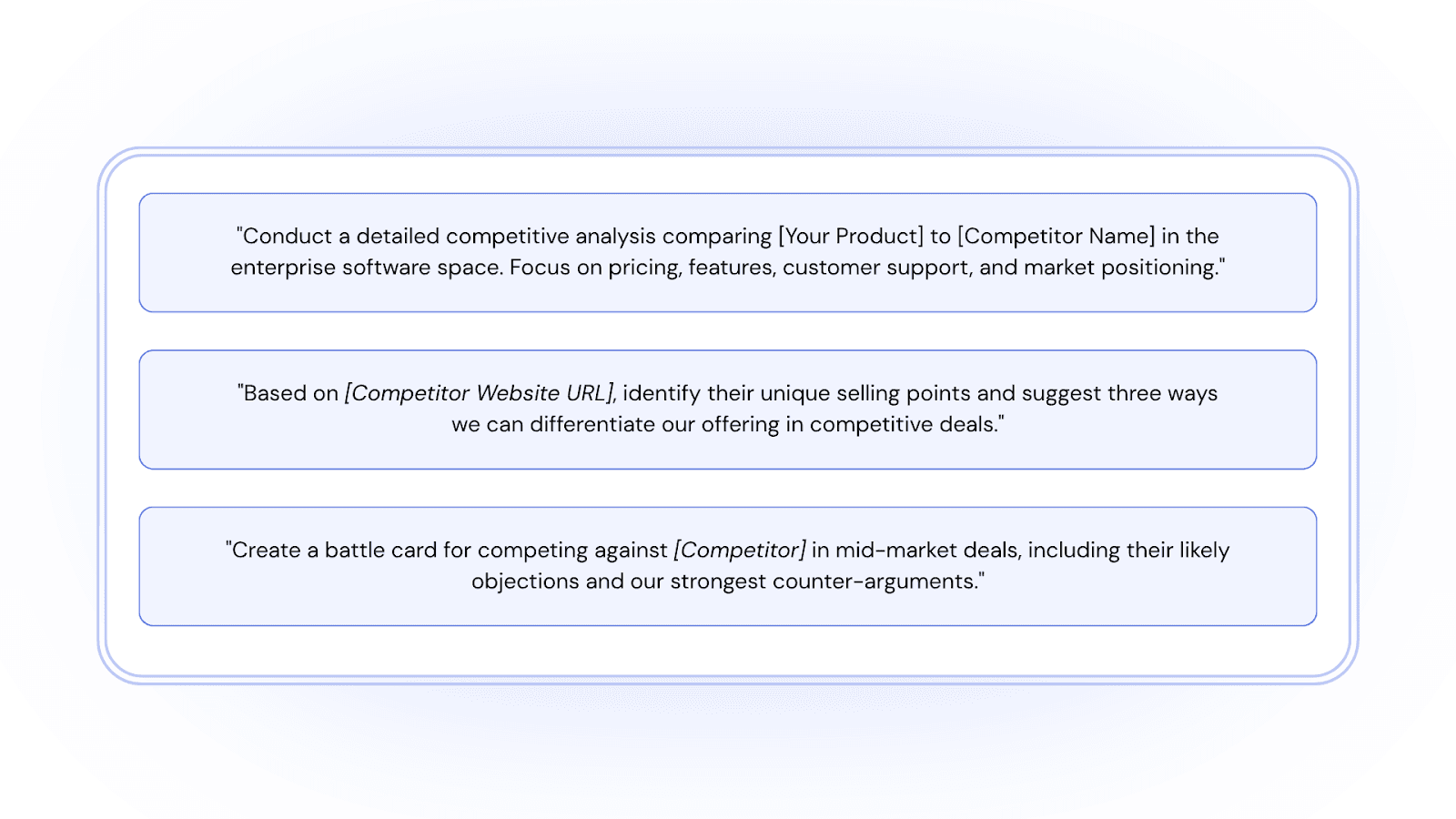
Ask it to find a competitor’s unique selling points based on their website and suggest differentiation strategies.
Create battle cards for specific competitors, including likely objections and strong counter-arguments. Competitive claims require current source verification since ChatGPT’s general knowledge may not reflect recent product changes, pricing, acquisitions, or positioning updates.
2. Detailed Sales Meeting Summaries
Important insights from sales meetings can often get lost. ChatGPT can distil key takeaways, action items, and strategic insights.
If you record meetings (with permission), use a transcription service and then feed the transcript to ChatGPT.
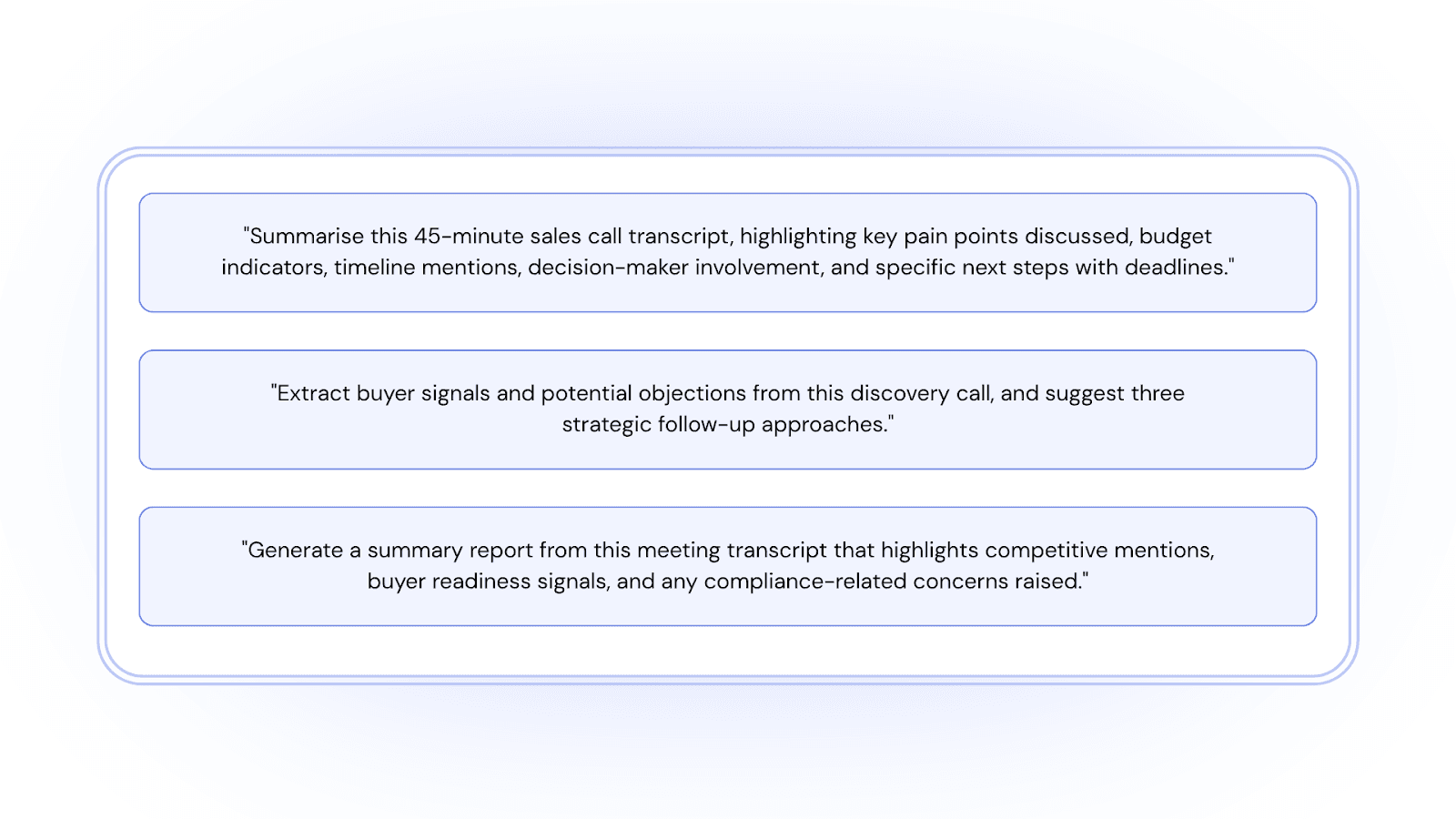
This is one of the strongest current use cases. Paste a meeting transcript and ask ChatGPT to extract commitments, objections, action items, and deadlines. Then ask it to draft a follow-up email based on the discussion points.
A strong summary is structured and evidence-based. It should quote or reference the relevant transcript section where possible, rather than presenting an unsupported interpretation as fact.
3. Crafting Customer FAQ Responses
Consistent and accurate answers build trust. ChatGPT can help maintain your brand voice while answering common questions.
Build an FAQ database. Ask ChatGPT to “Write a detailed response for a prospect asking about implementation timeline, training requirements, and ongoing support for our enterprise solution.”
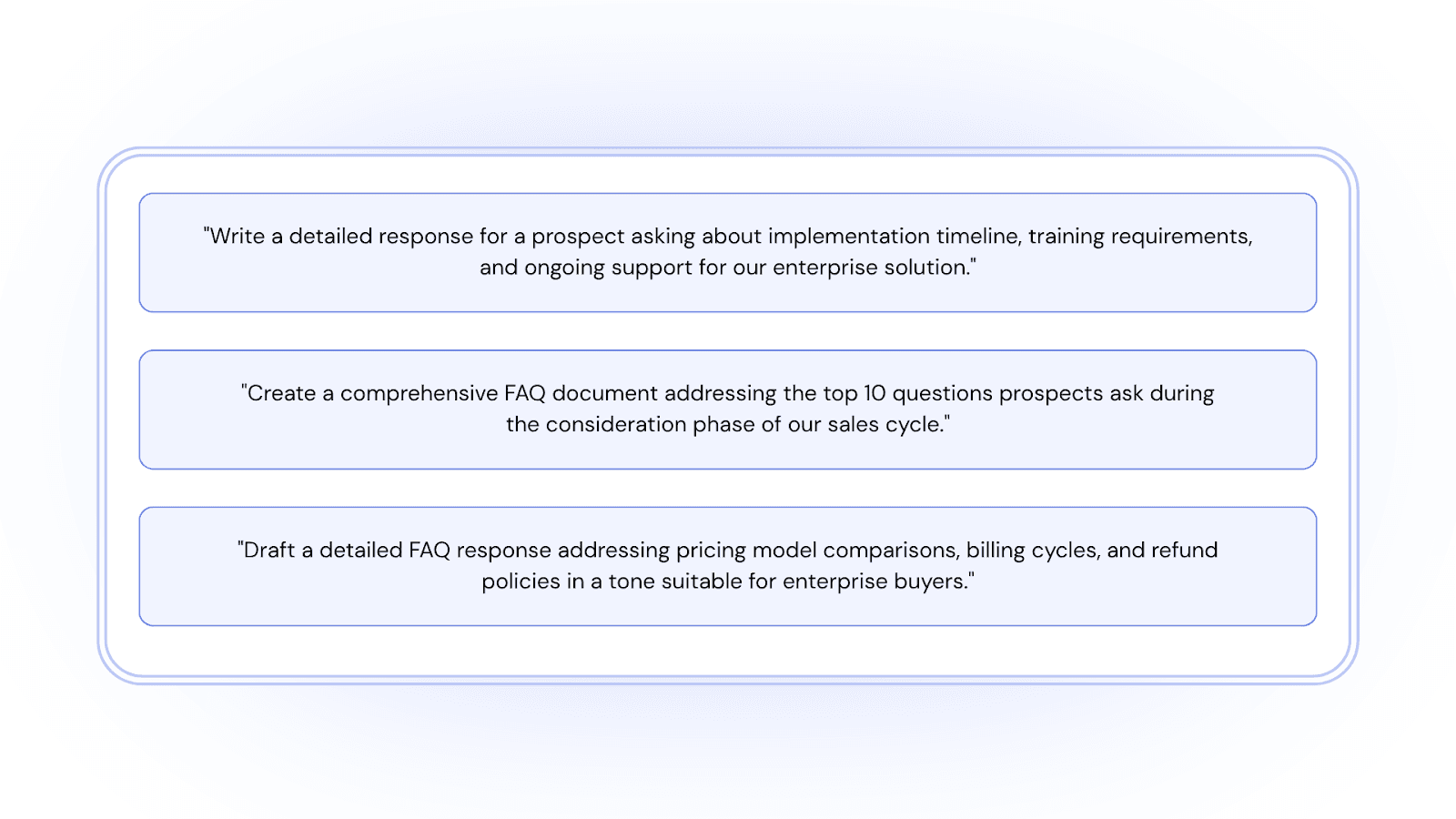
Create role-specific FAQ responses and include case studies or social proof.
Use responses to update help centre content or fuel chatbot auto-replies that still feel personal and brand-aligned.
4. Simplifying Technical Concepts
Many promising deals stall because prospects don’t fully grasp the technical details. ChatGPT helps by translating complex features into simple, relatable language that any decision-maker can understand.
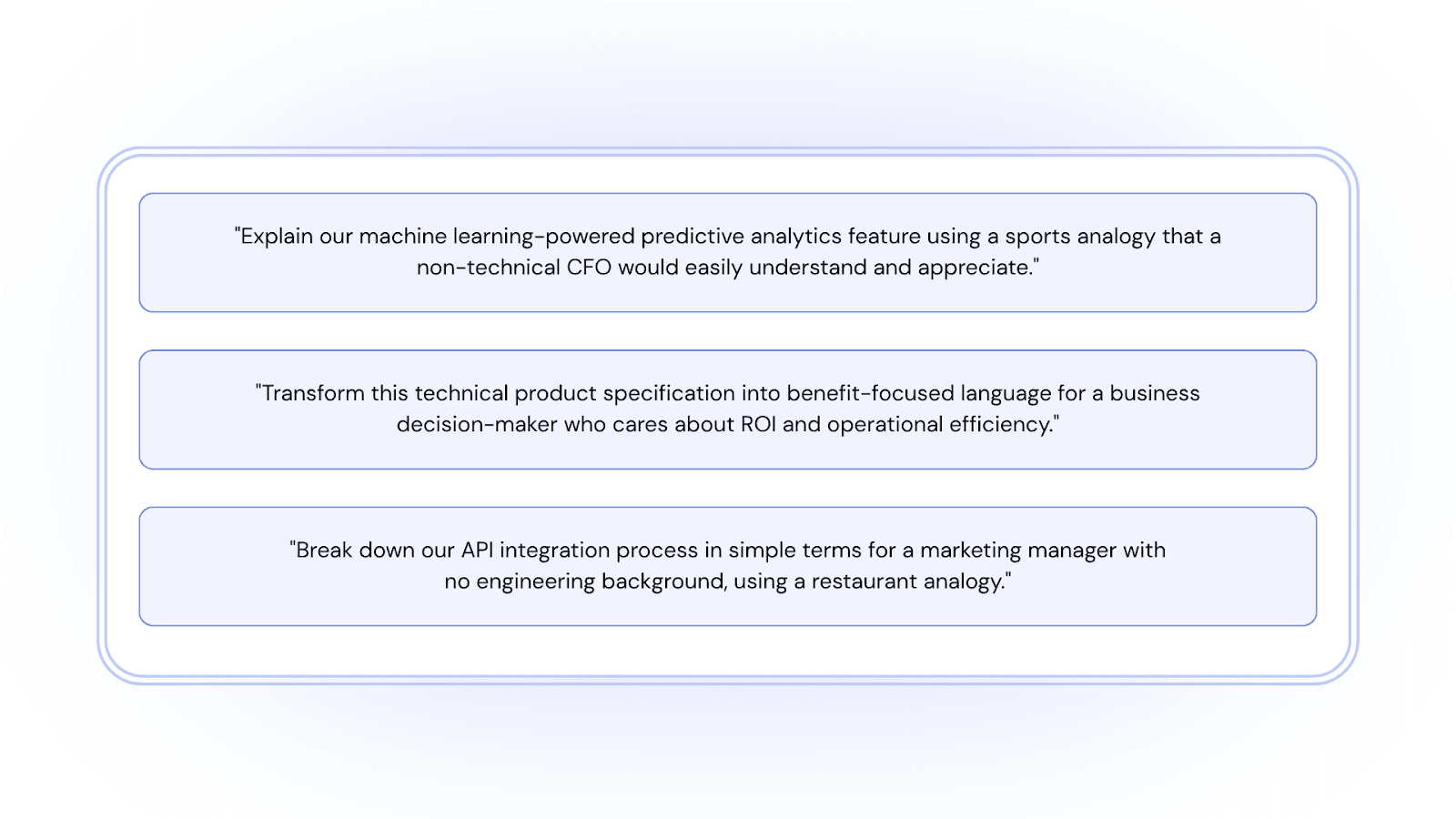
Ask ChatGPT to “Explain our machine learning-powered predictive analytics feature using a sports analogy that a non-technical CFO would understand.”
Turn technical product specifications into benefit-focused language for business decision-makers.
5. ChatGPT to Write Sales Proposals
Sales proposals are a big deal. ChatGPT can help draft sections or outline entire proposals.
Provide ChatGPT with key information about the client, their needs, your proposed solution, and pricing.
Use it to refine specific sections, improve clarity, and add persuasive language.
It can help tailor value propositions for different buyer personas or generate alternative wording based on industry context. ChatGPT should not independently invent ROI figures, customer results, security certifications, implementation timelines, or legal terms.
6. CRM and Pipeline Analysis
One of the most practical 2027 use cases is feeding ChatGPT exports from your CRM system. Activity logs, win/loss records, and deal history become valuable inputs for spotting pipeline trends, win-rate patterns, and deal-stage bottlenecks.
With connected data integrations, ChatGPT can now access approved data sources including data warehouses and business databases directly. Administrators control which connections are available and which users can access them.
Ask ChatGPT to review your pipeline data and identify accounts that may be ready for expansion based on usage, support volume, or recurring feature questions. This pattern recognition capability adds real value to account management workflows. You can also identify deals without recent activity, opportunities missing next steps, and common loss reasons.
For teams looking to scale their outreach alongside pipeline analysis, Sbl.so offers AI-powered LinkedIn, WhatsApp, and email automation using pre-warmed mailboxes that integrates with your existing sales workflow.
Advanced ChatGPT Strategies for Sales Growth and Retention
Use ChatGPT for sales enablement, customer expansion, and team development.
1. Sales Enablement Content Creation
Sales teams need a constant stream of content like pitch decks, battle cards, and case studies. ChatGPT is a great starting point.
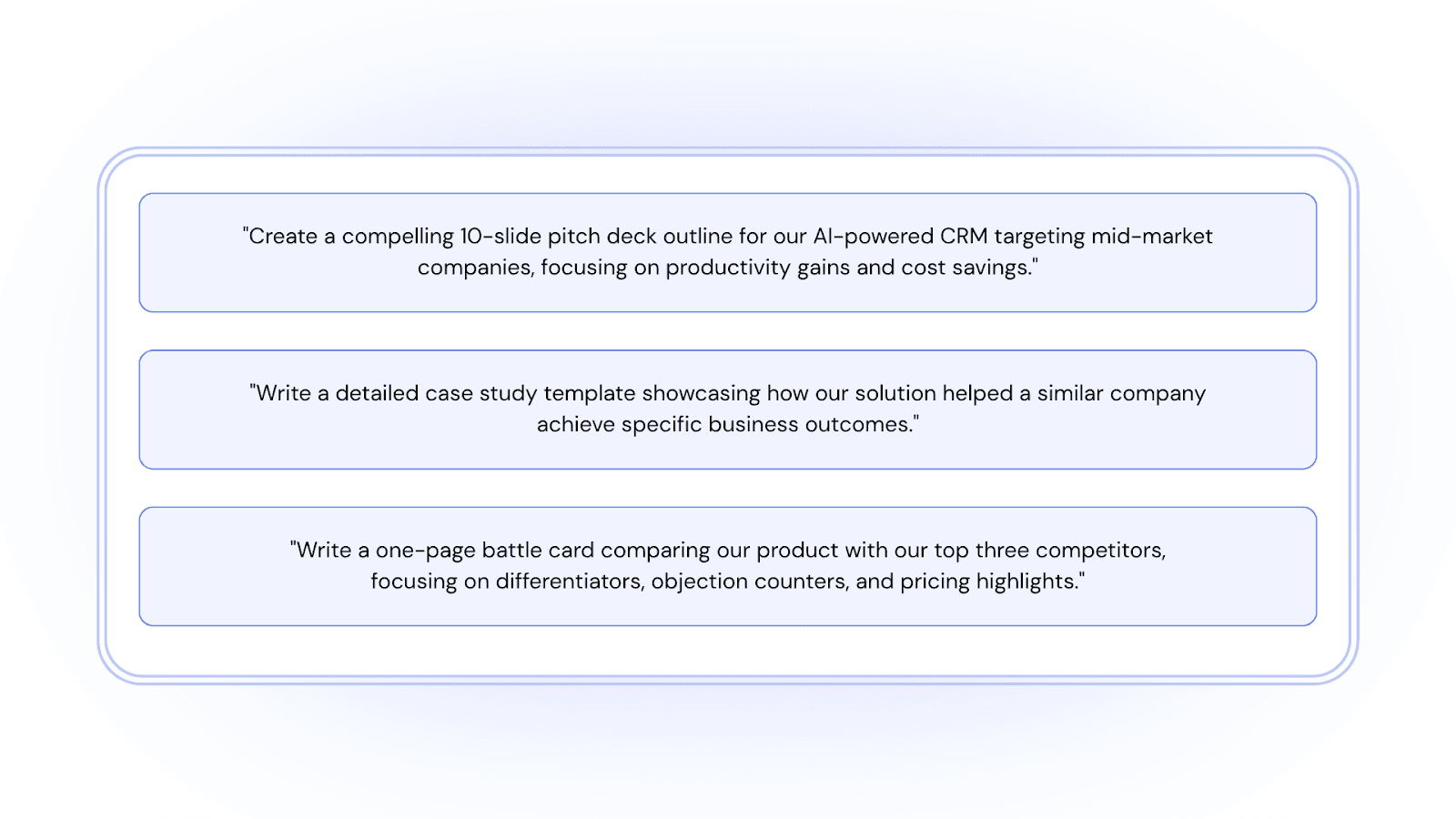
Prompt: “Create a 10-slide pitch deck outline for our AI-powered CRM targeting mid-market companies, focusing on productivity gains and cost savings.”
Use it to draft case study templates or outlines for whitepapers. The key is to provide a solid framework for your AI sales prompts.
You can also generate onboarding guides or one-pagers for new features that help reps explain products faster. The strongest current pattern is “draft with AI, finalize with humans,” especially when the material will be reused across the team.
2. Strategic Upselling and Cross-Selling with AI Sales Prompts
Customer retention and expansion are vital. ChatGPT prompts for upselling and cross-selling can help find opportunities and craft messages.
Ask ChatGPT to “Suggest three relevant cross-sell products for customers who recently purchased our basic marketing automation package, including timing and positioning strategies.”

Develop personalised upsell sequences for users approaching plan limits, emphasising value. Use ChatGPT cross-sell and upsell sequences that focus on customer success.
You can even map upsells to customer milestones and automate outreach via CRM integrations. Feed ChatGPT account data, support history, and renewal patterns to identify growth opportunities. These are signals, not proof of buying intent. Account teams should validate the customer’s needs before proposing an expansion.
3. Enhancing Sales Coaching and Role-Playing Scenarios
Continuous training is essential. ChatGPT can simulate challenging scenarios and offer practice opportunities.
Use prompts like: “Act as a sceptical enterprise CTO concerned about data security and vendor lock-in. Challenge me on our implementation approach.” This helps build a ChatGPT objection-handling prompt library.
Generate realistic objections a new sales rep might encounter, along with suggested response frameworks. A recurring recommendation is to ask for role-play scenarios with specific personas like a sceptical CTO or budget-conscious CFO to practice handling objections in a realistic way.
The prompt should define the persona, business context, difficulty level, and evaluation criteria. After each answer, you can ask ChatGPT to score your response for relevance, evidence, clarity, empathy, and next-step control.
This is especially useful for SDR and BDR teams building their skills.
4. Building Personal Brands for Sales Professionals
Social selling and thought leadership are increasingly important. HubSpot notes that 78% of salespeople who use social selling outsell peers who don’t. ChatGPT can help sales reps maintain a consistent and valuable online presence.
Prompt: “Write a LinkedIn post sharing three strategic lessons learned from our recent enterprise deal win, focusing on value for other sales professionals.”
Transform industry reports into engaging social media content like carousel posts.
For a deeper look at social selling strategies, check out our master social selling guide for 2027.
5. Automating Lead Gen and Appointment Scheduling
Use ChatGPT to draft initial outreach for lead magnets or to generate scripts for chatbots that pre-qualify leads.
For appointment setting, use GPT-powered prompts for appointment scheduling to draft compelling invitations and follow-ups.
Build automated follow-up sequences based on user responses or behavior.
You can also A/B test prompt variations to see what messaging leads to the highest booking rates.
Choosing the Right ChatGPT Sales Tool
While native ChatGPT works great for individual tasks, specialised sales platforms can supercharge your results with built-in integrations and sales-specific features.
The key is matching the tool to your specific bottlenecks. Are you drowning in research and prep work? Struggling with scattered information across multiple platforms?
Consider these factors:
Integration depth: How well does it connect with your existing CRM, email platform, and sales tools? ChatGPT is increasingly integrated through plugins, APIs, and workflow tools rather than used separately. Connected ChatGPT can use authorized business information, whereas a normal conversation without that context can’t reliably know current account status, internal pricing, deal history, or recent customer activity.
Data security: Ensure that any platform meets your security requirements and compliance standards. OpenAI states that business data is encrypted in transit and at rest, while connectors respect existing content permissions. Enterprise administrators can control access through roles and groups. It’s not safe to feed ChatGPT with sensitive personal data or confidential company information without proper controls and policy review.
Team adoption: The best AI tool is the one your team uses. Look for intuitive interfaces and gradual learning curves.
Measurable impact: Focus on platforms that provide clear ROI metrics like time saved, response rates improved, and deals accelerated.
The most successful sales teams use AI tools to eliminate routine tasks, surface better insights, and spend more time building relationships and closing deals.
Sbl.so exemplifies this approach by creating an AI-powered knowledge hub for sales teams. It centralises insights from calls, emails, and CRM data, then uses GPT to surface the right information exactly when you need it for coaching, proposals, and deal execution. It also offers LinkedIn, WhatsApp, and email automation with pre-warmed mailboxes to scale outreach while keeping messages personalised. SDR profiles start at $59-65 per profile per month.
Integrating ChatGPT into Your Sales Workflow: A Practical Guide
Strategic implementation is key to maximising the benefits of ChatGPT for sales.
1. Identify High-Impact Use Cases First
Focus on tasks that are time-consuming or bottlenecks, like prospect research, email drafting, or meeting summaries. A good first use case is a repetitive task with low external risk and a clear metric.
2. Start with a Foundational Context Prompt
Write a prompt that includes your company, ICP, product category, pricing or packaging assumptions, typical deal size, sales motion, and main goals. This sets the stage for all your ChatGPT interactions.
3. Add Role Instructions
Add instructions such as “act as an enterprise SDR,” “act as a sales enablement manager,” or “act as a sceptical buyer” to shape the output for your specific needs.
4. Choose the Right Technology Stack
- Native ChatGPT: Good for individual learning and prompt crafting.
- GPT-Embedded Sales Platforms: Best for seamless workflow integration and contextual insights. These often involve ChatGPT CRM integration prompts.
- Workspace Agents: For repeatable tasks that run on schedule. These can perform research, draft follow-ups, and update CRM records while keeping people involved in the workflow.
- Browser Extensions and Productivity Tools: Useful for content creation across various platforms.
- Specialised AI Sales Platforms: Consider platforms designed to augment your sales intelligence and workflow. Sbl.so helps you build and use a centralised knowledge base that can be supercharged with AI insights.
5. Build a Comprehensive Team Training Program
Cover AI fundamentals, prompt engineering, security, and role-specific use cases. Encourage building personal and shared prompt libraries.
6. Develop a Data Integration Strategy
Provide ChatGPT with relevant context from your CRM, meeting transcriptions, and sales collateral for more effective outputs. Always prioritise data security and use the least data necessary for each task.
7. Maintain Essential Human Elements
Always review and edit AI-generated content. Add personal touches, empathy, and strategic oversight. Use AI for drafts, humans for final delivery and relationship building.
Human approval is especially important before sending external outreach, updating material CRM fields, changing opportunity stages, making pricing or legal commitments, sharing customer information, or producing regulated communications.
8. Build a Reusable Prompt Library
Save the best outputs into a reusable prompt library or custom GPT for repeat use across the team. Revisit the workflow weekly and refine prompts based on reply rates, meeting bookings, win/loss signals, and time saved.
Best Practices for Maximising Your ChatGPT Sales Success
- Master Specific Context: The more detailed your prompt, the better the output. Instead of “Write a sales email,” try “Write a follow-up email for a CFO at a 200-person software company who expressed interest in our financial reporting tool but mentioned concerns about implementation complexity.”
- Ask ChatGPT to Identify Uncertainty: Include instructions like “Separate confirmed facts from assumptions,” “Do not invent missing information,” and “List claims that require verification.”
- Develop a Systematic Review Process: Check for factual accuracy, brand voice, compliance, personalisation, and clear calls to action.
- Implement Strict Data Security Protocols: Never input sensitive PII or confidential company data. Adhere to GDPR-compliant ChatGPT outreach templates and principles.
- Build Transparency: Be honest about AI assistance where appropriate and focus on AI as an enhancer, not a replacement.
- Start Small and Scale Systematically: Begin with a few use cases, measure results, and then expand.
- Create a Collaborative Learning Environment: Share successful sales prompt templates and best practices across the team.
- Protect Against Prompt Injection: Connected systems may contain malicious or misleading instructions embedded in documents, emails, or CRM fields. High-impact actions should require explicit confirmation.
AI-Driven Sales and What’s Next for ChatGPT in Sales
The role of AI, and specifically ChatGPT, for sales is set for dramatic expansion.
- Evolution to AI Sales Co-Pilots: Future iterations will offer more proactive assistance, monitoring pipeline health, predicting buyer behaviour, and suggesting strategic actions.
- Sales report shows that sales teams using AI-powered tools see a 50% increase in lead generation, according to data from Notta. This shift highlights the strategic role AI now plays in improving overall sales performance.
- Real-Time Multichannel Integration: Expect seamless integration across email, CRM, social selling platforms, and even video conferencing for live coaching.
- Hyper-Personalisation Revolution: AI will enable dynamic content creation that adapts in real-time to engagement and intent signals.
- Live Data-Driven Content Generation: ChatGPT will increasingly integrate with real-time data streams for reactive campaign creation and predictive content.
- Revolutionised Sales Training and Enablement: Personalised coaching, realistic simulations, and just-in-time learning will become the norm. Consider ChatGPT pipeline forecasting prompts as an emerging area.
For teams ready to adopt AI-powered sales workflows, AI sales automation from prospecting to qualification is worth exploring.
Upgrade Your Sales Strategy Using ChatGPT
In 2027, ChatGPT for sales is not just an option but a necessity for teams aiming for peak performance.
From ChatGPT lead generation to crafting hyper-personalised outreach prompts, its versatility is unmatched. By mastering ChatGPT sales prompts and integrating this Sales AI assistant strategically, you can significantly enhance productivity, deepen customer engagement, and drive revenue growth.
The future of sales belongs to those who embrace AI as a partner, combining its efficiency with indispensable human skills. The highest-value usage comes from combining verified prospect data + reusable prompts + human review + workflow integration.
Start using ChatGPT sales prompt templates and conversational AI lead-gen templates today, iterate, and prepare for a remarkable change in your sales outcomes.
Ready to build your team’s ultimate sales intelligence hub and unlock the full potential of AI in your sales process?
Explore Sbl.so and get started today. Your journey to AI-powered sales success begins now.
FAQs: Common ChatGPT Sales Questions
1. Can ChatGPT qualify sales leads?
Yes. ChatGPT helps create better qualifying questions, practice handling different prospect responses, and recognise buying signals in prospect communications. It can also help you build qualification frameworks and scoring systems. The final qualification still needs human judgment.
2. Does ChatGPT work for B2B and B2C sales?
Yes. The principles of clear communication, personalisation, and value-driven messaging apply to both markets. The AI sales prompts and approaches will be different based on your audience, sales cycle length, and decision-making complexity.
3. What metrics improve when using ChatGPT in sales?
Teams see improvement in the number of qualified leads generated, email open and reply rates, time saved on manual tasks, conversion rates at various stages of the funnel, and many other metrics. Relevant metrics may include time spent per task, research completion time, meeting-booking rate, qualified-opportunity rate, stage conversion, sales-cycle duration, and CRM data completeness.
4. Is ChatGPT safe for sales?
Safety depends on the product plan, configuration, permissions, organizational policies, source data, and user behavior. OpenAI describes encryption and administrative controls for business environments, including access management and connector permissions. Organizations should still apply data minimization, access controls, review procedures, retention policies, and compliance checks.
5. How do I get started with ChatGPT for sales?
Start with simple applications like email templates and prospect research. Master basic prompt techniques before moving to advanced strategies. Focus on one use case at a time rather than trying to do everything at once.
6. Can ChatGPT replace human salespeople?
No, and it shouldn’t. ChatGPT is a tool that handles routine tasks and provides insights, but sales success still depends on human relationship building, emotional intelligence, strategic thinking, and complex problem solving. It augments research, drafting, and analysis while humans handle trust, judgment, negotiation, and relationship-building.
7. How do I measure ROI from ChatGPT?
Track time saved, productivity improvement, lead generation, conversion rate improvement, and overall revenue growth. Avoid assuming that an increase in activity automatically means an increase in revenue. Most teams see ROI in 60-90 days when implemented correctly, though results vary by organization.
8. Can ChatGPT be used inside CRM workflows?
Yes. ChatGPT is increasingly integrated through plugins, APIs, and workflow tools rather than used separately. OpenAI describes integrations with tools such as Salesforce, HubSpot, Gmail, customer-call systems, and other business applications. Access and action permissions depend on the organization’s configuration.
9. Can ChatGPT help with discovery calls?
Yes, it can generate question lists, role-play objections, and help structure a call agenda. Many teams use it to prepare before calls and summarise afterward. It can also create account briefs, stakeholder maps, and hypotheses about business priorities.
10. Can ChatGPT summarise sales calls?
Yes, and this is one of the strongest current use cases when transcripts are available. Feed it a call transcript and ask for stated business problems, desired outcomes, objections, decision criteria, timeline, budget signals, stakeholders, commitments, action items with owners and dates, and recommended next steps.
11. What are workspace agents and how do they help sales teams?
Workspace agents are ChatGPT workflows that can perform repeatable tasks, use connected applications, run inside ChatGPT or Slack, and execute on a schedule. Sales teams use them for account monitoring, meeting preparation, follow-up generation, and CRM administration. They can be created from templates or from scratch and shared within a workspace.