By the end of this post, you will understand exactly what intent outreach is, why it crushes traditional cold outreach, and how to actually implement it without drowning in complexity. I’ll share real numbers, show you the shift happening across B2B sales teams, and explain why most “intent data” vendors are selling you snake oil while a few approaches genuinely work.
Intent Outreach: The Term We Coined, The Category We’re Building
Let me start by saying something that might sound arrogant but is simply true. We coined the term “intent outreach” at Sbl.so because nobody else was naming what modern sales teams actually need. Not “cold outreach.” Not “warm leads.” Not generic “intent data.” Intent outreach is a specific motion: reaching prospects based on real buying signals at the moment those signals fire.
Here’s what I mean. Traditional outbound looks like this: you build a list of 10,000 companies that “fit your ICP,” you blast them with templated sequences, and you pray for a 2% reply rate. Maybe 0.5% of those replies turn into meetings. The math is brutal. You’re essentially playing the lottery with your SDR team’s time.
Intent outreach flips this entirely. Instead of starting with a static list, you start with signals. Someone just raised a Series A? They’re probably hiring and building new systems. A VP of Sales just joined a company? They’re evaluating their stack. A prospect visited your pricing page three times this week? They’re comparing you to competitors right now.
The difference in outcomes is not marginal. It’s dramatic.
The Numbers That Made Us Abandon Volume-Based Prospecting
I want to share some data that changed how we think about this. We ran 47 campaigns over 8 months comparing two approaches. The first approach was classic volume outreach: good ICP fit, personalized first lines, solid sequences. The second approach was intent outreach: smaller lists, but every contact had a recent trigger event like funding, job change, or competitor engagement.
Volume outreach: 3.2% reply rate, 0.8% meeting rate.
Intent outreach: 11.4% reply rate, 4.1% meeting rate.
That’s not a minor improvement. That’s 5x more meetings from fewer sends. And the quality of those meetings was dramatically better because we weren’t educating cold prospects. We were talking to people already thinking about the problem.
Here’s the thing most people miss. When you reach someone based on a trigger event, your message isn’t cold anymore. It’s timely. You’re not interrupting their day with something irrelevant. You’re showing up at the exact moment they need help. The entire psychology of the interaction changes.
What Exactly Are Intent Signals?
Let me break down what intent outreach actually tracks because the term “intent data” has been so polluted by vendors selling garbage that nobody knows what’s real anymore.
First-party behavioral signals are the gold standard. These are actions prospects take on your own properties. Someone visits your pricing page. Someone watches your demo video. Someone downloads your case study. Someone comes back to your site three times in a week. These signals are yours, they’re accurate, and they’re high-intent because the prospect is actively researching you.
Trigger events are the second category. These are observable changes in a company’s situation that correlate with buying. Funding rounds mean new budgets. Leadership changes mean new priorities. Rapid hiring means scaling problems. Technology stack changes mean integration opportunities. These events are public, verifiable, and predictive.
Engagement signals are the third type. Someone comments on your LinkedIn post. Someone engages with your competitor’s content. Someone asks a question in a community about a problem you solve. These signals show active interest in your category even if the prospect hasn’t found you yet.
Then there’s third-party intent data, and I have to be honest here. Most of it is junk. Companies sell you lists claiming “these accounts are researching your category” based on de-anonymized web traffic and probabilistic guessing. We tested several major providers and the correlation with actual pipeline was embarrassingly weak. Maybe 10-15% better than random lists. Not worth the premium pricing.
The intent signals that actually work are specific, verifiable, and recent. “This company researched CRM solutions” is useless. “This company’s new VP Sales visited three competitor pricing pages and commented on a post about sales automation yesterday” is actionable.
How Intent Outreach Actually Works Step by Step
Let me walk you through the actual process because most content about this topic stays frustratingly abstract.
Step one: Define your signal thesis. Don’t track everything. Pick 2-3 signals that strongly correlate with purchase in your specific category. For us at Sbl.so, the signals that matter are: companies hiring SDRs or BDRs (means they’re scaling outbound), companies that just raised funding (means they have budget), and people engaging with content about LinkedIn automation or AI sales tools (means they’re actively researching).
Your signals will be different. A CRM might care about companies switching from spreadsheets. A security tool might care about companies that just had a breach or compliance event. The point is specificity. Not “any company that could use our product.” Only companies showing active signals right now.
Step two: Build detection infrastructure. You need systems that catch these signals in near real-time. For first-party signals, that means proper website tracking with company identification. For trigger events, that means monitoring funding databases, job boards, and news feeds. For engagement signals, that means watching LinkedIn activity and community mentions.
This is where most teams fail. They manually check signals once a week and by then the moment has passed. Intent outreach requires automation. The signal fires, you detect it within hours, you reach out while it’s still relevant.
Step three: Match signals to playbooks. Each signal type needs a specific messaging approach. A funding announcement gets a different message than a job change. A pricing page visit gets handled differently than a competitor engagement. You’re not just personalizing the first line. You’re tailoring the entire value proposition to the signal context.
Example: “Congrats on the Series B. When teams scale from 5 to 20 SDRs, the biggest bottleneck is usually pipeline quality degrading because you’re casting wider nets. We help companies maintain conversion rates while scaling volume. Worth a 15-minute diagnostic?”
That message only makes sense if you know they just raised money and are hiring SDRs. Without the signal, it’s just another cold email.
Step four: Execute fast and across channels. Speed matters more than you think. A study we ran showed that reaching out within 24 hours of a signal generates 3x higher response rates than reaching out a week later. The prospect is still thinking about the trigger. Your message lands while the context is fresh.
And you need multi-channel coverage. Some signals suggest LinkedIn is the right channel. Others suggest email. Some warrant both. Intent outreach isn’t about blasting every channel. It’s about picking the right channel for the specific signal and prospect.
The Old Game vs The New Game
Let me contrast these two approaches directly because the difference matters for how you structure your entire sales operation.
Volume outreach says: Build the biggest list you can that fits your ICP. Send as many messages as possible. Accept that most will be ignored. Scale with more SDRs sending more volume.
The problems with this approach are well documented by now. Reply rates are declining every year as inboxes get more crowded. You burn through your total addressable market quickly. Your SDRs spend most of their time on accounts that will never buy. Your brand takes a hit from spammy outreach. And you need to hire constantly just to maintain pipeline.
Intent outreach says: Build smaller lists based on real signals. Send fewer, better-timed messages. Focus SDR time on accounts showing active interest. Scale with better signal detection, not more headcount.
The math is completely different. If intent outreach generates 5x the meetings per send, you can maintain the same pipeline with 80% fewer sends. Your SDRs focus on qualified conversations instead of cold prospecting. Your brand improves because you’re reaching people at relevant moments. And you can scale without hiring proportionally.
I’m not saying volume outreach is dead. Some companies still make it work, especially in massive markets with low competition. But for most B2B companies, especially in crowded categories, the volume game is getting worse every year. Intent outreach is getting better as signal detection improves.
Common Questions About Intent Outreach
Does intent data actually work for sales outreach?
The honest answer is: some of it works brilliantly and most of it is garbage. First-party signals and verifiable trigger events consistently outperform. Third-party “topic intent” from black-box vendors rarely moves the needle enough to justify the cost. The key is testing. Run controlled comparisons between intent-based lists and standard ICP lists. Measure pipeline, not just replies. If the intent data isn’t generating significantly more pipeline per account, drop it.
How many signals should I track?
Start with 2-3. Seriously. I know the temptation is to track everything, but more signals means more noise and more complexity. Pick the signals that have the strongest theoretical connection to purchase in your category. Validate them with actual pipeline data. Only add more signals once you’ve proven the first few work.
How do I align marketing and sales around intent signals?
This is where most companies struggle. Marketing wants to use intent for ads and nurture. Sales wants it for direct outreach. The signals overlap but the timing differs. The solution is shared definitions. What score threshold triggers sales outreach versus marketing nurture? What signals are “hot” versus “warm”? Build these definitions together and codify them in your tools.
What’s the difference between intent and propensity?
This distinction matters more than most people realize. Propensity means “likelihood to buy based on patterns.” A machine learning model might say this account has high propensity because companies like them historically buy solutions like yours. Intent means “active signals of current interest.” They visited your site, they engaged with relevant content, they showed observable behavior.
Propensity is useful for prioritization. Intent is useful for timing. The best approaches combine both: prioritize high-propensity accounts, then reach out when intent signals fire.
How does intent outreach interact with ABM?
They’re complementary. ABM says “focus resources on a defined set of target accounts.” Intent outreach says “within those accounts, reach out when signals indicate readiness.” You can run ABM without intent (but you’ll waste effort on accounts that aren’t in-market). You can run intent outreach without ABM (but you might pursue signals from accounts that don’t fit your ICP). Together, they’re powerful: right accounts, right timing.
Intent Outreach and Category Positioning
Here’s something most content about intent data misses entirely. Intent outreach isn’t just a tactic. It’s a category positioning strategy.
When you reach out based on a trigger event, you’re not just selling your product. You’re positioning your entire category as relevant to that moment. “You just raised funding. Companies at your stage typically face X problem. That’s exactly what [category] solves.”
This is subtle but important. You’re not competing for attention against every possible solution. You’re claiming the moment. You’re saying: this trigger means you should be thinking about this category, and we’re the leader in it.
The companies winning in intent outreach aren’t just good at detecting signals. They’re good at connecting those signals to a category narrative that makes their solution feel inevitable. “You hired a new VP Sales. New sales leaders always want to modernize outreach. Modern outreach means AI-driven automation. That’s what we do.”
Every touch reinforces the category, not just the product. Over time, when these triggers fire in your market, prospects already associate them with your category and your company.
Where Most Teams Get Intent Outreach Wrong
I’ve seen dozens of teams try to implement intent outreach and fail. The mistakes are predictable.
Mistake one: Trusting bad data sources. They buy expensive third-party intent data without validating it. Six months later, they realize the “high intent” accounts weren’t any more likely to buy than random accounts. Always test. Always measure pipeline impact, not vendor promises.
Mistake two: Tracking too many signals. They set up alerts for every possible trigger and drown in noise. Their SDRs spend more time sorting through signals than actually reaching out. Start narrow. Expand only what’s proven.
Mistake three: Slow response times. They detect signals but don’t act on them for days or weeks. By then the moment has passed. Intent outreach requires operational speed. If you can’t reach out within 24-48 hours of a signal, the signal loses most of its value.
Mistake four: Generic messaging despite specific signals. They know the prospect raised funding but send a message that could apply to anyone. The whole point of intent outreach is relevance. If your message doesn’t reference the signal and connect it to a specific value proposition, you’ve wasted the opportunity.
Mistake five: No measurement framework. They can’t tell whether intent outreach is actually working better than their old approach. You need controlled tests. Same SDRs, same time period, different list sources. Compare pipeline generated per account touched. Without this, you’re flying blind.
Building Intent Outreach Infrastructure
Let me talk about what you actually need to implement this. There’s a build versus buy decision here, and the right answer depends on your scale and resources.
For signal detection, you need: website visitor identification (to catch first-party signals), monitoring for trigger events (funding, job changes, tech stack), and social listening for engagement signals. Some teams build this with a patchwork of tools. Others use platforms designed for it.
For enrichment, you need data that helps you act on signals. When you detect a signal at the account level, you need to find the right contact. When you find a contact, you need their email and LinkedIn. Data enrichment tools fill these gaps.
For outreach execution, you need systems that can act fast. Manual outreach doesn’t scale when you’re processing dozens of signals daily. LinkedIn automation and email sequencing become essential. The challenge is doing this without getting banned or looking spammy.
For analytics, you need pipeline attribution. Which signals led to which meetings and deals? Without this feedback loop, you can’t optimize your signal selection or messaging.
Why We Built Sbl.so Around Intent Outreach
I’ll be direct about this because it’s relevant. Sbl.so was built from day one around the intent outreach motion. Not as an afterthought or a feature addition. As the core architecture.
Our Signals feature captures real-time buying signals: people engaging with specific posts, companies hiring for relevant roles, funding announcements, job changes. These aren’t black-box propensity scores. They’re observable, verifiable triggers.
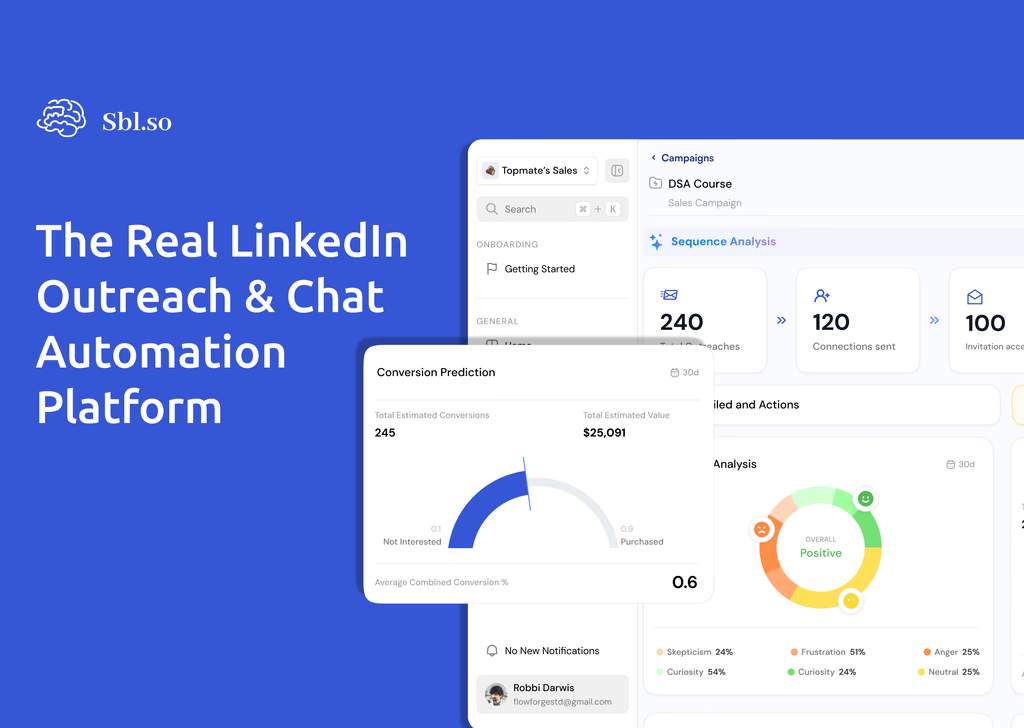
When a signal fires, Sbl.so doesn’t just alert you. It can automatically enroll that prospect into a personalized sequence across LinkedIn and WhatsApp. The message references the specific signal. The follow-up adapts based on response.
And here’s what makes it different from every other LinkedIn automation tool: the AI doesn’t stop when someone replies. It continues the conversation. It handles objections. It qualifies the prospect. It books the meeting. You’re not just automating the first touch. You’re automating the entire intent-to-meeting journey.
That’s why we coined the term. Intent outreach isn’t about buying more data. It’s about building a system that detects signals, acts on them immediately, and converts them into pipeline without requiring an army of SDRs. We’ve been building toward this since 2023, and we’re already processing 40,000+ outreach touches per month through the platform.
The Future of B2B Prospecting
I think we’re at an inflection point. The volume-based cold outreach era is ending. Not because it never worked, but because the math has deteriorated to the point where it only works at massive scale with massive budgets.
The next era is signal-driven. The companies that win will be the ones who detect buying signals faster, act on them sooner, and connect them to compelling category narratives. They’ll do more with less. They’ll build pipeline without burning through their TAM. They’ll compete on relevance, not volume.
Intent outreach is the playbook for that era. Not “intent data” as vendors sell it. Not another layer of black-box scores. Real signals, fast action, relevant messaging, automated follow-through.
That’s what we’re building at Sbl.so. And based on what we’re seeing in our own campaigns and our customers’ results, the teams that adopt this motion early are going to have a significant advantage for years.
If you want to see how this works in practice, start with the AI sales automation guide or check out how to scale LinkedIn outreach without getting banned. The pieces are all there. Intent outreach isn’t complicated once you understand the framework. It just requires thinking differently about prospecting than what most sales teams have been taught.