Let me be honest with you. WhatsApp sales automation sounds amazing on paper. High open rates. Instant delivery. Personal touch. But here’s what nobody tells you. Most businesses are losing money on it.
I’ve watched companies dump thousands into WhatsApp automation tools. And most of them are losing money on it.
That’s not automation failing. That’s the wrong approach to WhatsApp sales automation entirely.
Today I’m breaking down exactly what works. What doesn’t. And whether WhatsApp automation is right for your business in 2026.
The Promise of WhatsApp Sales Automation
WhatsApp has over 2 billion users now. Your customers are already there. They check it more than email. More than LinkedIn. More than anything else on their phone.
So the logic seems simple. Reach customers where they live. Get better engagement. Close more deals.
And the numbers support this. WhatsApp messages consistently outperform email and SMS in open and response rates. The gap is massive.
But here’s where it gets tricky. Opens mean nothing if nobody responds. And that’s exactly what’s happening with most WhatsApp automation strategies.
Major WhatsApp Changes You Need to Know in 2026
Before we get into pros and cons, you need to understand three massive shifts that happened this year. These changes fundamentally alter how WhatsApp automation works.
Meta’s AI Chatbot Ban (January 2026)
On January 15, 2026, Meta banned general-purpose AI chatbots from WhatsApp Business. This means no more ChatGPT wrappers. No open-ended conversational agents. No AI assistants distributed through WhatsApp as the main product feature.
The rule is clear: task-specific AI that solves defined business problems is allowed. General-purpose assistants are not.
If your automation relies on a ChatGPT-style bot that can answer anything, you’re now violating Meta’s terms. You need business-specific automation focused on lead qualification, appointment booking, or customer support.
Per-Message Pricing Model
Meta switched from conversation-based pricing to per-message billing around July 2025, and 2026 rate cards now fully reflect this structure. Under the old model, you paid one flat rate for a 24-hour conversation window regardless of message count.
Now you pay for every single message. Marketing messages cost roughly $0.01-0.02 in India, around $0.025 in the US, and $0.13-0.14 in Germany and Western Europe. Utility and authentication messages run 50-95% cheaper. Customer service messages within 24-hour windows remain free.
This changes your ROI calculations completely. 10,000 marketing messages to different regions now have vastly different cost profiles.
Portfolio-Based Messaging Limits
Meta now manages messaging limits at the business portfolio level, not per individual number. New portfolios typically start at 250 business-initiated conversations per 24 hours.
Quality scores matter more than ever. The system uses a three-level rating: Green (high), Yellow (medium), and Red (low). Persistent negative feedback can reduce limits or halt tier progression entirely.
The Real Pros of WhatsApp Sales Automation
Let’s start with what actually works. Because WhatsApp automation isn’t all hype. When done right, it’s incredibly powerful for sales automation.
24/7 Availability Without Hiring Staff
Your leads don’t wait for business hours. They browse at midnight. They have questions at 6am. They want answers now.
WhatsApp automation handles this perfectly. Your system responds instantly. No delays. No “we’ll get back to you tomorrow.”
This alone can transform your conversion rates. Speed matters in sales. The first business to respond usually wins.
Instant Response Times That Convert
Here’s a stat that should scare you. Most customers buy from whoever responds first. Not the best product. Not the lowest price. The fastest response.
Automated WhatsApp sales systems respond in seconds. Your competitors are still checking their inbox. You’ve already started the conversation.
That speed advantage compounds over time. More conversations started. More deals closed.
Scalability That Email Can’t Match
Want to reach 10,000 leads this month? With manual outreach, you’d need an army. With WhatsApp business automation, you need one system.
The scalability is real. You can run thousands of conversations simultaneously. Each one personalized. Each one moving toward your goal.
This is where AI sales funnel automation really shines. Set it up once. Let it run forever.
Cost Efficiency That Actually Adds Up
Compare WhatsApp to traditional sales channels. Cold calling costs $300+ per qualified lead. LinkedIn outreach costs time and premium subscriptions. WhatsApp? Pennies per message in most markets.
Even with per-message pricing, the math works. Utility and authentication messages often cost under $0.01 per message. When you factor in significantly higher click-through rates on WhatsApp buttons versus SMS and email, the ROI becomes clear.
Companies report substantially lower customer acquisition costs with WhatsApp compared to email and SMS combined.
The 72-Hour Free Messaging Window
Here’s something most people miss. Click-to-WhatsApp ads trigger a 72-hour free messaging window. During this period, all template types including marketing messages are free.
This is one of the biggest performance marketing opportunities in 2026. Run ads that drive WhatsApp conversations. Then message aggressively during the free window. Your cost per conversion drops dramatically.
WhatsApp Flows for Higher Conversions
WhatsApp Flows let users complete actions without leaving the chat. They can fill forms, select options, choose dates, and submit information all within WhatsApp.
Studies show Flows significantly increase conversion rates compared to sending users to external websites. No context switching. No abandonment friction.
For ecommerce and service businesses, Flows have become essential for abandoned cart recovery, appointment booking, and lead capture.
Rich Data Collection for Better Targeting
Every WhatsApp conversation generates data. What questions do prospects ask? Where do they drop off? What objections come up most?
Smart automation tools capture all of this. You learn exactly what your audience cares about. Then you optimize accordingly.
This feedback loop makes your data enrichment infinitely better over time.
Global Reach Without Global Teams
WhatsApp dominates internationally. India. Brazil. Germany. Southeast Asia. If you’re selling globally, WhatsApp isn’t optional. It’s essential.
Automation lets you reach these markets without building local teams. One system. Multiple languages. Global coverage.
The Ugly Cons of WhatsApp Sales Automation
Now for the part most vendors won’t tell you. WhatsApp automation has serious downsides. Ignore them and you’ll waste money. Or worse, get banned.
Meta’s Onboarding Process Takes Time
Want to get started with WhatsApp Business API? Prepare for friction.
Meta’s signup process requires business verification, documentation, and technical setup through a BSP (Business Solution Provider). Onboarding timelines are often described in weeks rather than days.
I’ve seen businesses wait months to get fully approved. Others get rejected for unclear reasons. Some give up entirely.
This isn’t a minor inconvenience. It’s a fundamental barrier to entry, especially for smaller businesses lacking technical resources.
Template Constraints Limit Creativity
Most WhatsApp automation tools force you into templates. Pre-approved messages. Limited customization options.
Here’s the problem. Your prospects aren’t the same. Their needs differ. Their pain points vary. Sending identical messages to everyone isn’t personalization. It’s spam with extra steps.
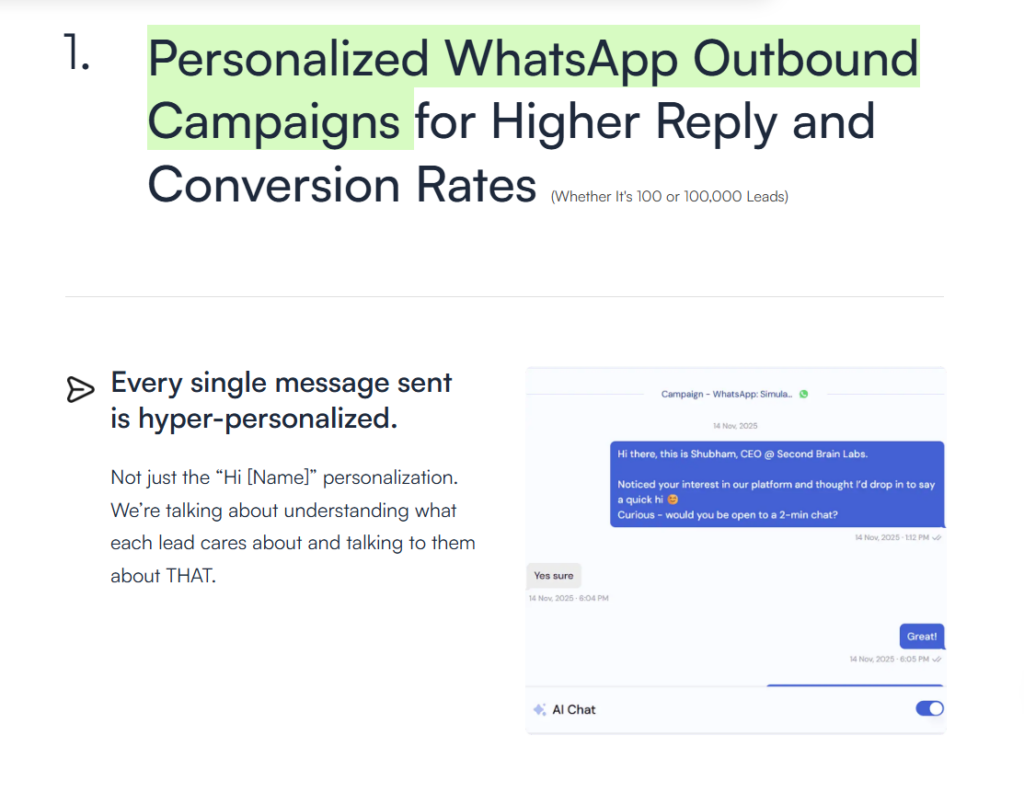
This is where most WhatsApp automation tools fail completely. They call it “AI” but it’s just a scheduler.
Sbl.so is actually one of the only tools that sends personalized messages at scale. Not template broadcasts. Real personalization based on each prospect’s profile, company, and likely pain points. Every message feels tailored because it is.
Per-Message Costs Add Up Fast
The per-message pricing model changes everything. At high volumes, costs balloon. Especially when your reply rates are low.
Do the math on 10,000 messages with 3% engagement. That’s 9,700 wasted conversations. At $0.025 per message in the US, you’ve spent $242 on messages that went nowhere. In Western Europe at $0.13+ per message, that’s over $1,200 wasted.
Provider markups make it worse. Some platforms charge significant percentages on top of Meta’s rates. A zero-markup provider versus a marked-up provider means substantial monthly differences at scale.
Quality Rating and Risk of Throttling
This is the scariest risk. WhatsApp throttles accounts based on quality rating. Too many complaints? Reduced limits. Users marking you as spam? Risk of suspension.
The quality rating system uses three levels: Green (high), Yellow (medium), and Red (low). Sustained negative feedback can reduce limits or halt tier progression.
New portfolios now start at just 250 messages per day until you build up quality history. That’s a slow ramp. Scaling takes patience and consistently positive engagement.
Technical Limitations That Frustrate
WhatsApp wasn’t built for sales automation. It shows.
You can’t schedule messages freely. You must use approved templates outside 24-hour windows. You can’t message people who haven’t opted in.
Template rejections happen for minor formatting issues. Variables must have surrounding context. Group messages and calls aren’t supported through the official Business API. The API is primarily for 1:1 structured messaging.
These limitations make complex sales workflows nearly impossible with standard tools.
The Reply Problem Nobody Talks About
Let’s say your broadcast actually works. People reply. Great, right?
Not really. Now you’re drowning in manual work. Every response needs a human reply. You’ve just created more work, not less.
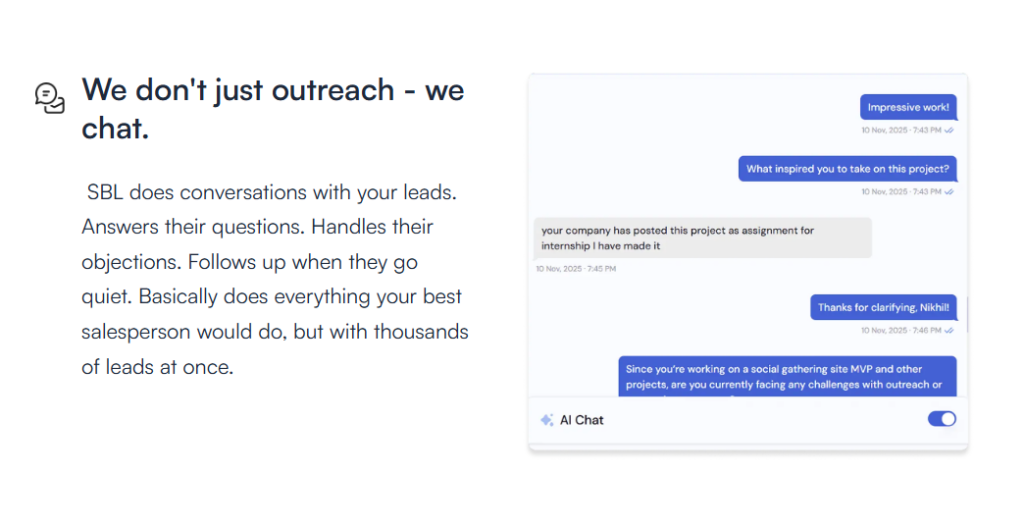
Most automation tools send messages. They don’t handle conversations. That’s not automation. That’s just moving your manual labor to a different platform.
Sbl.so solves this completely. When someone replies, our AI continues the conversation. It answers questions. Handles objections. Qualifies leads. You get actual automation, not half-measures.
The AI Policy Restrictions
Since January 2026, you can’t use general-purpose AI chatbots on WhatsApp. This eliminates a lot of previous automation approaches.
Your AI must be task-specific and business-focused. Lead qualification? Fine. Appointment booking? Fine. A ChatGPT wrapper that answers any question? That violates Meta’s terms.
Organizations using non-compliant AI face immediate suspension. Audit your automation now if you haven’t already.
What Makes WhatsApp Automation Actually Work in 2026
After testing dozens of tools and running thousands of campaigns, here’s what separates winners from losers.
Conversational AI vs Template Broadcasting
This is the fundamental divide. Old-school tools broadcast templates. Modern tools have conversations.
Template broadcasting gets ignored. It feels like spam because it is spam. Same message to everyone. No adaptation. No personality.
Conversational AI engages prospects like a real salesperson would. It asks questions. It responds to their specific concerns. It builds rapport.
The difference in results is dramatic. Low single-digit engagement with templates. Significantly higher engagement with real conversations.
Handling the Entire Sales Process
Real automation doesn’t stop at sending messages. It handles:
- Outreach: Personalized first messages that get responses
- Qualification: Smart questions to identify hot leads
- Objection handling: Addressing concerns automatically
- Follow-ups: Re-engaging cold leads contextually
- Handoffs: Routing qualified prospects to your team
This is what proper WhatsApp marketing looks like. Not just messaging. Full-funnel automation.
Integration With Your Existing Stack
WhatsApp automation shouldn’t exist in a vacuum. It needs to connect with your CRM. Your analytics. Your other channels.
The best tools sync everything automatically. Contacts. Lead scores. Conversation history. Deal stages.
This creates a unified view of every prospect across LinkedIn, WhatsApp, and email.
When WhatsApp Sales Automation Makes Sense
Not every business should jump into WhatsApp automation. Here’s when it actually makes sense.
You Have Inbound Traffic to Convert
Running Click-to-WhatsApp ads? Getting website visitors on WhatsApp? This is where automation shines brightest.
Warm leads expect fast responses. Automation delivers that. The ROI on inbound WhatsApp automation is usually excellent.
The 72-hour free messaging window makes ad-driven WhatsApp campaigns especially profitable.
Your Target Market Uses WhatsApp
This sounds obvious but matters enormously. WhatsApp dominates in certain markets. India. Brazil. Most of Europe. If your customers live there, WhatsApp is non-negotiable.
In North America? LinkedIn might be better for B2B. Know your audience before committing.
You’re Doing High Volume Outreach
Manual WhatsApp outreach works fine at small scale. 50 messages a day? Handle it yourself.
But at scale? You need automation. Nobody can manually handle thousands of conversations. The economics only work with smart automation.
You Have a Clear Sales Process
Automation amplifies what works. If your sales process is chaos, automation just creates faster chaos.
Define your qualification criteria first. Know what makes someone a good lead. Then let automation filter for you.
When WhatsApp Automation Doesn’t Make Sense
Some businesses should avoid WhatsApp automation entirely. At least for now.
Your Leads Don’t Use WhatsApp
Some demographics barely touch WhatsApp. Enterprise executives in North America, for example. They live on LinkedIn and email.
Forcing WhatsApp on audiences that don’t use it wastes money. Meet your prospects where they already are.
You’re Selling Complex Enterprise Deals
$500K contracts don’t close via WhatsApp. These deals need relationship building. Face-to-face meetings. Trust developed over months.
WhatsApp can supplement enterprise sales. It shouldn’t replace your SDR and BDR teams for complex deals.
You Can’t Handle the Compliance Risk
Heavily regulated industries face extra scrutiny. Financial services. Healthcare. Legal.
WhatsApp compliance in these sectors is tricky. Healthcare organizations face challenges with protected health information because Meta won’t sign certain data processing agreements. Financial services face recordkeeping requirements that WhatsApp’s architecture doesn’t easily support.
One mistake can mean fines. Understand the risks before diving in.
Understanding the 2026 Messaging Tier System
The tier system changed significantly this year. Here’s what you need to know for planning your WhatsApp sales automation strategy.
Portfolio-Level Limits
Messaging limits are now managed at the business portfolio level, not per individual number. All numbers in your portfolio share the highest achieved tier. This simplifies scaling but requires careful quality management across all your numbers.
Tier Progression
The 2026 tier structure works like this:
- Tier 0 (Starting): 250 unique contacts per 24 hours
- Tier 1: 1,000 unique contacts per 24 hours
- Tier 2: 10,000 unique contacts per 24 hours
- Tier 3: 100,000 unique contacts per 24 hours
- Tier 4 (Unlimited): No daily cap
To progress tiers, you need to maintain a Green or Medium quality rating and consistently use around 50% of your current daily limit over a rolling period. Meta evaluates tier upgrades roughly every 6 hours.
Most Commonly Asked Questions on WhatsApp Sales Automation
Is WhatsApp sales automation compliant with 2026 privacy laws?
Yes, when done correctly. You need explicit opt-ins obtained outside WhatsApp. First-party data only. Clear unsubscribe options. Meta requires template approval for business messages.
The key is consent. Don’t message people who haven’t agreed to hear from you. This protects both you and your prospects.
GDPR requires specific, informed consent naming WhatsApp as a channel and Meta as the data processor. European operations need tighter controls than Meta’s baseline policy demands.
What’s the difference between WhatsApp Business and WhatsApp Business API?
WhatsApp Business is the free app for small businesses. Limited features. Manual messaging. Broadcast caps at 256 contacts. Single-device oriented with basic labels and auto-replies. No real automation.
WhatsApp Business API is the programmatic interface for real automation. It connects to tools like Sbl.so. It enables chatbots, integrations, CRM sync, multi-agent shared inboxes, and scaling to thousands of daily contacts.
If you’re serious about automation, you need the API.
How much does WhatsApp automation cost per message in 2026?
Costs vary by message category and country. Marketing messages range from about $0.01-0.02 in India to $0.025 in the US and $0.13-0.14 in Germany and Western Europe. Utility and authentication messages cost 50-95% less. Customer service messages in 24-hour windows are free.
Click-to-WhatsApp ads trigger 72-hour free messaging windows. Factor this into your campaign planning.
Can I automate WhatsApp without coding?
Absolutely. Modern tools like Sbl.so offer no-code builders. You define your goals. Set qualification rules. The system handles the rest.
Technical expertise helps but isn’t required anymore.
How do I avoid getting my WhatsApp number throttled or banned?
Several things protect you. Respect the 24-hour messaging window for templates. Get explicit opt-ins before messaging. Don’t send promotional content to cold lists. Monitor your quality rating religiously.
Start new portfolios slowly. Gradually ramp up volume over weeks, not days. Use at least 50% of your current tier limit consistently with good engagement to progress to higher tiers.
Most throttling happens from aggressive cold outreach. If you’re providing value and getting engagement, you’re usually safe.
What conversion rates should I expect from WhatsApp automation?
Template broadcasts typically see low single-digit engagement. That’s terrible.
Personalized conversational automation sees significantly higher engagement. Sbl.so clients regularly hit strong conversion rates by focusing on relevant, personalized messaging.
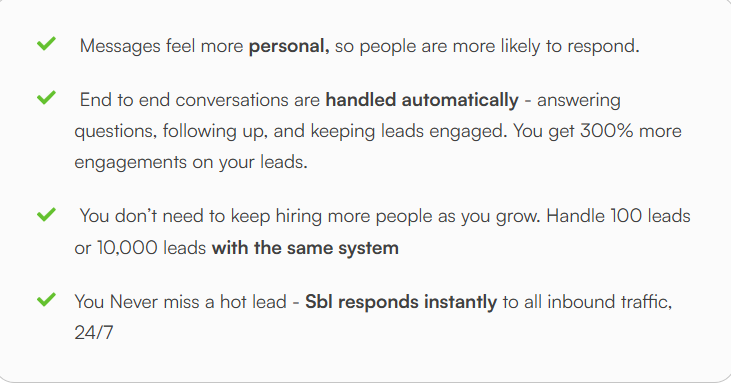
The approach matters more than the channel.
Can WhatsApp automation handle multiple languages?
Yes. Good automation tools detect language preferences and respond accordingly. You can run campaigns in multiple languages simultaneously.
This is essential for global businesses targeting diverse markets.
How does WhatsApp automation integrate with my CRM?
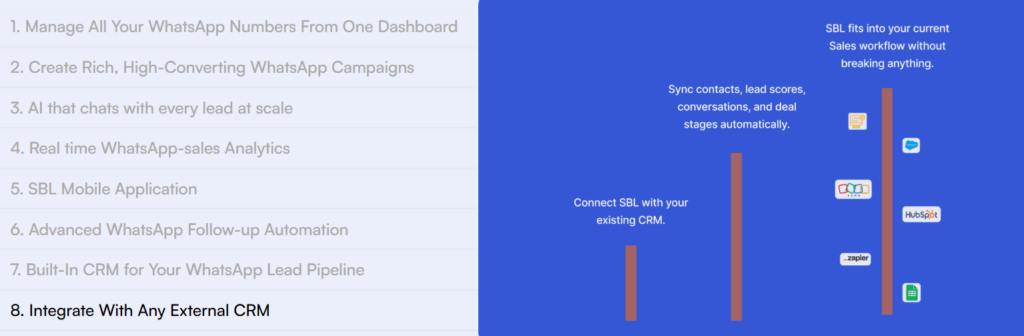
Most tools offer native integrations with HubSpot, Salesforce, Zoho, and others. Conversations sync automatically. Lead scores update in real-time. Deal stages progress based on conversation outcomes.
Sbl.so includes its own CRM plus integrations with existing systems.
What’s the best way to collect WhatsApp opt-ins?
Multiple channels work. Website widgets with clear WhatsApp checkboxes. Click-to-WhatsApp ads. QR codes on marketing materials. Lead magnets exchanged for WhatsApp contact.
The key is offering value in exchange for permission. Nobody opts in without a reason. And remember: Meta requires opt-in obtained outside WhatsApp before sending proactive business messages.
Should I use WhatsApp automation for cold outreach?
This is risky. WhatsApp’s policies technically prohibit unsolicited promotional messages. Many businesses try cold outreach anyway. Some succeed temporarily. Many get throttled or banned.
If you go this route, keep volumes low. Ensure messages provide genuine value. Be prepared to face quality rating issues.
How does WhatsApp compare to email automation?
WhatsApp wins on engagement. Open and response rates consistently outperform email by wide margins.
Email wins on scale and cost. No per-message fees. No ban risks. Easier compliance. More mature tooling for large-scale nurture.
Smart businesses use both. WhatsApp for high-intent conversations. Email for nurturing at scale. Video outreach for standing out.
Can AI fully replace human salespeople on WhatsApp?
Not completely. Task-specific AI handles a large portion of conversations brilliantly. Qualification. Basic objections. Information requests. Scheduling.
Complex negotiations still need humans. Emotional situations need humans. High-value closes need humans.
The best approach is AI handling volume while humans focus on high-impact moments. And remember: the AI must be task-specific and business-focused to comply with Meta’s January 2026 restrictions.
Is the free WhatsApp Business app enough for sales automation?
For very small operations or single-agent workflows, it can work. Beyond that, its limitations make it unsuitable: 256-contact broadcast caps, lack of advanced automation, single inbox constraints, and no CRM integration.
If you’re doing serious sales automation, you need the API.
The Bottom Line on WhatsApp Sales Automation
WhatsApp automation isn’t inherently good or bad. It’s a tool. Results depend entirely on how you use it.
Broadcasting templates to cold lists? You’ll waste money and risk throttling.
Running personalized conversations with warm leads? You’ll see incredible ROI.
The technology has matured in 2026. True conversational AI exists now. Personalization at scale is possible. But only with the right tools and within Meta’s policy boundaries.
Most WhatsApp automation tools are stuck in the past. They broadcast templates and call it innovation. They leave you drowning in manual replies. They don’t comply with the January 2026 AI restrictions.
Sbl.so does it differently. Personalized outreach. Conversational AI that actually sells within compliance boundaries. Full-funnel automation from first message to closed deal. Strong conversion rates instead of single-digit engagement.
You can try it free for 7 days. No credit card required. Plans start at $99/month with unlimited numbers.
Stop broadcasting into the void. Start having conversations that convert.
Because when automation actually works, scaling becomes effortless.